It has been more than 10 years since I really gave Buddhist teachings, with the exception of one or two seminars and conferences. I guess a long break helped in gettting focus on key activities of my life. Rekindling the passion to learn and teach helps is something I wanted to do for a long while. Hence, I felt I was ready to return to teaching.
I volunteered to teach Sunday Dhamma school at a local Buddhist community and went straight for the Youth classes (form 2 and beyond). When I ageed to take the class, I felt that this group of student would be able to best appreciate my somewhat different approach and would be ripe for a much more socially-engaged Buddhism.
Well never mind all that. In this morning's class I was tested in my ability to first engage with student in the age group of 14 and above. The challenge to trying to understand the teenagers and get them interested to explore the values of the Buddha's teachings away from traditional sutta quoting and "Buddha said......." methodologies. The is just too much detatched lecture approach making Dhamma classes either too class room orientated hence causing the lessons to be another school lesson - something student are trying to shake off in the weekends. On the otherhand, there may be too much flexibility to please and address the student - putting in so-called fun activities. Both ways the value of Dharma can get watered down.
In my class, I had to confront the fact that almost all the students who were there attended the class because they felt "there was no choice". Their parents "forced" them to attend. Whatever the reason or reasons were none from the 14 students asked their parents why? When asked why did they not object or dialogue with their parents, one of them responded that it was out of "respect" not to question. Come from a background and training where I have often encouraged my kids to speak up, this response was a little bit a surprise to me.
Chinese in an Asian community often equate respect as fear and not trust. Respect goes both ways as well. I guess in the same manner Siddhartha respected his father, Sudhodana. Siddhartha questioned and made his decisions. Finally, Sudhodana accecpted and respected the path Siddhartha took. Respect is also not the blind violent objections to anything the parent brings-up.
One challenge for our youth is the ability to decide what they want and to be firm to go the whole nine yards and later communicating that mesage effectively. In order to decide, there must be opportunity where youths are given the opportunity to have right information with the appropriate exchanges and getting each other to understand.
As a parent, I feel the bigger challenge is the ability to gain the "mind share" of our children. Our society is a society where information (read: messages) are bombarded to us on a daily basis. From the start of the day, there is the radio. Besides spattering of news, most information are about trival stuff like celebrity gossips, songs and music. Just try listening to Light & Easy for a day and you will see what I mean. Now try flipping to Radio 4 and you have "matsallehs wanna-be" talking (mostly) rot. I wrote about this before in earlier articles. Television is not much different. Satisfaction of the advertisers is paramount. Some good documentry however, offers some ray of hope though.
Our lives are very much guided by these information and messages which is oftened aimed at making decision about lifestyle in the material world. Apart from mass media, the schools struggle to get into the minds of the students as well. Leaving little time and space for parents, what more Dhamma school teachers.
Hence, getting connected with students is really key. Once that done, communication willl begin to flow or at least meaningful dialogue....

INTERCONNECTIONS. Everything is connected, somehow.
Monday, January 09, 2006


Friday, January 06, 2006
Children Not Important-lah
Someone has a heart! (Jan 7, 2006)
It is heartening to know that our leaders to care. In the NST today it is reported that the Chief Minister of Penang critized the developer, Motif Era for it action.
More importantly is what next? Can State Government do something positive and give priority to the education process of the children affected.
Children Not Important-lah (Jan 6, 2006)
Or is it that learning is not important.Or where is the heart? If you have read the story of SJK (C) Sin Chuan in Butterworth and how the developer, the owners of the land tried to tear down the school to make way for a "mixed development" (read: more money to make, school does not matter), you will begin to wonder where is the heart of the owner if this developer.
If anyone who lived in Seremban can recall, about 10 years ago a similar situation happened to the Tamil school of Convent Seremban. The poor primary schools students were still in the school when the workers began dismantaling the school. What happened in Butterworth is not the first time.
Executing the court's judgement almost immediately - giving little chance for any appeal to be made? Tearing the school down - while classes are going on? What is this? Never mind if the developers have rights to the land. Never mind if there are only 49 students there. How can they do this while classes are going on?
Couldn't the developers have done it during the school hoildays and give notice to the parents and schools? Maybe they have done that but. Maybe there were resistence but going ahead to tearing a school down on the third day of school with kids inside?
What's the priority? Where is the heart? WHERE IS THE HEART?

It is heartening to know that our leaders to care. In the NST today it is reported that the Chief Minister of Penang critized the developer, Motif Era for it action.
More importantly is what next? Can State Government do something positive and give priority to the education process of the children affected.
Children Not Important-lah (Jan 6, 2006)
Or is it that learning is not important.Or where is the heart? If you have read the story of SJK (C) Sin Chuan in Butterworth and how the developer, the owners of the land tried to tear down the school to make way for a "mixed development" (read: more money to make, school does not matter), you will begin to wonder where is the heart of the owner if this developer.
If anyone who lived in Seremban can recall, about 10 years ago a similar situation happened to the Tamil school of Convent Seremban. The poor primary schools students were still in the school when the workers began dismantaling the school. What happened in Butterworth is not the first time.
Executing the court's judgement almost immediately - giving little chance for any appeal to be made? Tearing the school down - while classes are going on? What is this? Never mind if the developers have rights to the land. Never mind if there are only 49 students there. How can they do this while classes are going on?
Couldn't the developers have done it during the school hoildays and give notice to the parents and schools? Maybe they have done that but. Maybe there were resistence but going ahead to tearing a school down on the third day of school with kids inside?
What's the priority? Where is the heart? WHERE IS THE HEART?
Thursday, January 05, 2006
Our Homeschooling Journey – Thoughts and Reflections
Starting Jan 3, 2006, Amrita, our eldest daughter, begins her own journey in learning process. She begins he life as a Primary 4 student in Kelana Jaya. Over the past 2 years Amrita has been persistently and consistently talking to us about experiencing the more structured learning environment in a school. At first, we thought it was the influence of her school-going friends and that she wanted to be with them. Perhaps it was partially the friends. At first, we put it aside and left things as it was. Over time, as she brought this matter up again (and again) it dawn us that she was serious. She was also consistent and most importantly she felt strongly about taking this path of formal educational experience.
As our mode of homeschooling is adopting the “unschooling” approach which basically respects the child’s decision and to put “trust our children” to guide us guide them in their educational experience, this approach led us to finally allow her to be enrolled in school.
We looked around the schools and we agreed that the current state of the public schools is out as we had to consider an environment where the transition from homeschooling can take place as seamlessly as possible. Through Sook Ching’s recommendation, we explored this private school – which pioneered the “fungate” education approach for pre-school students and has recently introduced primary education. We felt this school was closest to a smooth transition from homeschooling. Hence the beginning of Amrita’s schooling experience. She will complete her primary education and we will leave it to her if she feels she want to continue into secondary school or revert back to homeschooling later. We are prepared for that. Whatever it will be, we emphasized that she must go through certain process and not give up half-way. We are aware of the challenges, the shortcomings and that a lot of work needs to be put in. I guess Amrita is already aware of it. She is very excited and is looking forward to it.
Our families, both our parents were equally excited (and relieved that we have come to our senses – at least where Amrita is concern) as well. They have been helping in their preparation of the first day at school.
What are some of the thoughts that made use make this decision for Amrita. Firstly, Amrita’s persistence and consistency in articulating what she wants. Next, Amrita’s learning style. She is very academic inclined and love learning. With us, she asks very indepth questions and often go into very interesting discussions. She is also inclined to a more structured learning environment and feels comfortable with this approach. Most important to me was her desire to experience formal schooling – something we cannot deprive her from. The home schooling environment did not give her a chance to interact with other people as much as she would like to. Hence, we saw that she could not articulate her thoughts well outside our family environment.
So, what happens to Sam and Arian? Arian, is ok as he still has time. For Sam, the ocean seems too big and sky too high at this point in time. I guess it is still not the right time yet, even if she wanted to go into school now.
Some thoughts about homeschooling……. coming soon….
Wai Leng & K V
As our mode of homeschooling is adopting the “unschooling” approach which basically respects the child’s decision and to put “trust our children” to guide us guide them in their educational experience, this approach led us to finally allow her to be enrolled in school.
We looked around the schools and we agreed that the current state of the public schools is out as we had to consider an environment where the transition from homeschooling can take place as seamlessly as possible. Through Sook Ching’s recommendation, we explored this private school – which pioneered the “fungate” education approach for pre-school students and has recently introduced primary education. We felt this school was closest to a smooth transition from homeschooling. Hence the beginning of Amrita’s schooling experience. She will complete her primary education and we will leave it to her if she feels she want to continue into secondary school or revert back to homeschooling later. We are prepared for that. Whatever it will be, we emphasized that she must go through certain process and not give up half-way. We are aware of the challenges, the shortcomings and that a lot of work needs to be put in. I guess Amrita is already aware of it. She is very excited and is looking forward to it.
Our families, both our parents were equally excited (and relieved that we have come to our senses – at least where Amrita is concern) as well. They have been helping in their preparation of the first day at school.
What are some of the thoughts that made use make this decision for Amrita. Firstly, Amrita’s persistence and consistency in articulating what she wants. Next, Amrita’s learning style. She is very academic inclined and love learning. With us, she asks very indepth questions and often go into very interesting discussions. She is also inclined to a more structured learning environment and feels comfortable with this approach. Most important to me was her desire to experience formal schooling – something we cannot deprive her from. The home schooling environment did not give her a chance to interact with other people as much as she would like to. Hence, we saw that she could not articulate her thoughts well outside our family environment.
So, what happens to Sam and Arian? Arian, is ok as he still has time. For Sam, the ocean seems too big and sky too high at this point in time. I guess it is still not the right time yet, even if she wanted to go into school now.
Some thoughts about homeschooling……. coming soon….
Wai Leng & K V
Thursday, November 17, 2005
Sharing Not our Culture Anymore?
In 2006, Amrita will be going to school. Yes, she has decided and consistently requested for it and finally we decided to give it a go and enrolled her in a private school in PJ. This is posting is not about Amrita but my experience in going round trying to get a car pool in place. I will share this thought another day.
I looked up the school and ask if there are any students who would want to car pool. It turned out that there are at least three families in the same section where I live who send their children to the same school. Through the school, I asked if they are willing to make arrangement to car pool to send our children. This save time, share time and on the environmental level, put a car or two less on the road - good example to talk to our children about saving the environment. Plus, of course, our children get to have new friends.
But alas, both the parents the school called did not commit, they sounded disinterested and had the same reply, "let me talk to my husband first". Three weeks have passed, no reply.
I am beginning to wonder if they understood what car pooling is all about and why they are not interested? Is is fear of their children safety - that's a valid excuse. Is it that they prefer very private lives or trust no one? Could it be we do not know each other - we did leave our number and offer to meet and get to know one another. Let's not even talk about the environment bit.
What every the reason may be, I am concern that our community has lost the culture of sharing and community spirit. Yes this is the same community where thieves broke into our home one morning two years ago. Despite my wife's screams, no one came out. Our immediate neighbour heard but told us (yes, actually told us) they thought it was something else. Where we came from as kids, we would all run out and stick out heads out to find out / to help / or just be a busy body. Here we stay in our house and thank (whoever) that it's the neighbour that got hit.
I sincerely home I am wrong. You might your own thoughts.
I looked up the school and ask if there are any students who would want to car pool. It turned out that there are at least three families in the same section where I live who send their children to the same school. Through the school, I asked if they are willing to make arrangement to car pool to send our children. This save time, share time and on the environmental level, put a car or two less on the road - good example to talk to our children about saving the environment. Plus, of course, our children get to have new friends.
But alas, both the parents the school called did not commit, they sounded disinterested and had the same reply, "let me talk to my husband first". Three weeks have passed, no reply.
I am beginning to wonder if they understood what car pooling is all about and why they are not interested? Is is fear of their children safety - that's a valid excuse. Is it that they prefer very private lives or trust no one? Could it be we do not know each other - we did leave our number and offer to meet and get to know one another. Let's not even talk about the environment bit.
What every the reason may be, I am concern that our community has lost the culture of sharing and community spirit. Yes this is the same community where thieves broke into our home one morning two years ago. Despite my wife's screams, no one came out. Our immediate neighbour heard but told us (yes, actually told us) they thought it was something else. Where we came from as kids, we would all run out and stick out heads out to find out / to help / or just be a busy body. Here we stay in our house and thank (whoever) that it's the neighbour that got hit.
I sincerely home I am wrong. You might your own thoughts.
Tuesday, November 15, 2005
Kids Going to University in Malaysia?
This is a very big struggle for me. Should I prepare my kids for Malaysian universities for for foreign one? Some say the decision would be decided by my pockets....other might feel that it would be a matter of the quality of the university.

So, how did the the recent THEE Ranking of University Malaysia (UM) and University Sains Malaysia (USM) affect us a parents. Reading through the paper everyday I noticed that everyone from politicians to academicians have lots to say - more oftenly than not, they contradict each other - like clowns running everywhere in the circus. I am not not concern about the the politicians and bureaucrats think. However, due credit should be given to academicians who provide a much broader perspective and depth to the issue. I particularly like the article by Azmi Shahrom's "How to Judge a Good University" published in the SUN. Azmi recognizes the weaknesses as well as the strength of UM and USM.

I personally think there is just too much talk and no action - no clear acceptance and acknowledgement of the problem by the relevent authorities and department , almost everyone is trying to explain and come up with "shoot from the hip solution". With the exception of our Prime Minister acknowledging the issue - everyone else seems to be more interested to explain. Until to day, no clear goals, activities, timeframe and deliverables have been announced. No one seems to be looking at the problem from the holistic standpoint. Is anyone interested in improving the ranking of our universities again?
The VC of MU is one person who seems to "happy" as the individual rankings were good while the USM's VC was appoint consultants.
I guess I will be taking my time to decide if my kids will go to UM or USM - I have another 10 years or so. Hopefully, within that time someone will wake up and be really bold to challenge the norm and make improvements to our universities.
K V

So, how did the the recent THEE Ranking of University Malaysia (UM) and University Sains Malaysia (USM) affect us a parents. Reading through the paper everyday I noticed that everyone from politicians to academicians have lots to say - more oftenly than not, they contradict each other - like clowns running everywhere in the circus. I am not not concern about the the politicians and bureaucrats think. However, due credit should be given to academicians who provide a much broader perspective and depth to the issue. I particularly like the article by Azmi Shahrom's "How to Judge a Good University" published in the SUN. Azmi recognizes the weaknesses as well as the strength of UM and USM.

I personally think there is just too much talk and no action - no clear acceptance and acknowledgement of the problem by the relevent authorities and department , almost everyone is trying to explain and come up with "shoot from the hip solution". With the exception of our Prime Minister acknowledging the issue - everyone else seems to be more interested to explain. Until to day, no clear goals, activities, timeframe and deliverables have been announced. No one seems to be looking at the problem from the holistic standpoint. Is anyone interested in improving the ranking of our universities again?
The VC of MU is one person who seems to "happy" as the individual rankings were good while the USM's VC was appoint consultants.
I guess I will be taking my time to decide if my kids will go to UM or USM - I have another 10 years or so. Hopefully, within that time someone will wake up and be really bold to challenge the norm and make improvements to our universities.
K V
Sunday, November 13, 2005
Why are we in such a hurry?
I was on my way home this afternoon from Bangsar I nearly crashed into a Proton driven by a young (I guess in mid twenties) lady. This happened as I was at a U-turn making my way to the main road which was pretty jammed up. She drove her car in-front of me just when I was easing my way to the main road, despite the fact that I had my indicators lights on and there was ample space for me to go in. This lady seemed to be in such a hurry to get somewhere that she seemed to forget that this was a traffic jam and eveyone will have to inch their way. I finally got to the main road, onto a different lane which the lady was driving in and guess what? I reached the destination faster than she did. Sounds like the rabbit and the hare story?
Not quite. Have you ever encountered situations like this? If you are on the road long enough you will experience this sort of experience on a daily basis. Almost everytime I drive on the highways, there will be several drivers who would tailgate me just inches behind me not giving me chance to move my vehicle to the left in order to allow the person behind me to pass.
Have you encountered situations such as this...?
Anyone knows what's the hurry?
KV
Not quite. Have you ever encountered situations like this? If you are on the road long enough you will experience this sort of experience on a daily basis. Almost everytime I drive on the highways, there will be several drivers who would tailgate me just inches behind me not giving me chance to move my vehicle to the left in order to allow the person behind me to pass.
Have you encountered situations such as this...?
Anyone knows what's the hurry?
KV
Tuesday, October 25, 2005
The Wonderful Sound of "Papa"
Just last week my son, Arian finally...... called "papa". It is was a joy to hear that. Of course, it took a lot of work. You got to take him for car rides (let him drive, for that matter), go bonding, doing some "male" stuff. All in all it took him 15 months to call "papa", with a very strong Beijing tune.
What is interesting is that from the time he could call me, he became closer to me. More willing to be closer to me and got me to just do things or play with him. I find this an important period my son and I are going through. And this is most important to spend enough time with him.
Well what happens next - better train him to "mama" - finally succeeded this week! So little Arian is been going around calling "papa" and "mama".
The next challenge is to get him to call "jie jie" (sister). He is starting to do it although his pronunciation is still not so clear, but is is getting there.It was a joy the first time over 9 years ago when Amrita called "papa". It was joy over 8 years ago when Samanta did the same.
It is a very powerful affirmation of biological and emotional ties between a parents and children. It is also a strong yet gentle reminder of our responsibilities as parents to positively nurture our children. Just as important, is to see strong ties grow to keep the family together.
 (l-r, Samanta, Amrita and Arian)
What is interesting is that from the time he could call me, he became closer to me. More willing to be closer to me and got me to just do things or play with him. I find this an important period my son and I are going through. And this is most important to spend enough time with him.
Well what happens next - better train him to "mama" - finally succeeded this week! So little Arian is been going around calling "papa" and "mama".
The next challenge is to get him to call "jie jie" (sister). He is starting to do it although his pronunciation is still not so clear, but is is getting there.It was a joy the first time over 9 years ago when Amrita called "papa". It was joy over 8 years ago when Samanta did the same.
It is a very powerful affirmation of biological and emotional ties between a parents and children. It is also a strong yet gentle reminder of our responsibilities as parents to positively nurture our children. Just as important, is to see strong ties grow to keep the family together.
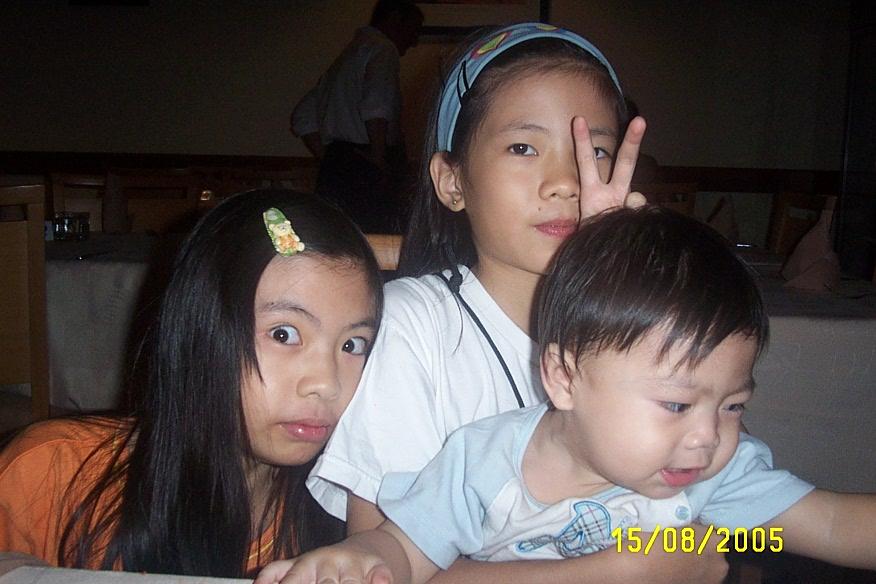 (l-r, Samanta, Amrita and Arian)
We are again reminded....
..... of our vulnerability against the forces of nature. The world (the media, really) is starting to forget the tsunami of December 2005, the politicizing of the effects of hurricane Rita and Katrina and we start to have our lives back to some "normality" again. The media has started to show regular programs again. Suddenly, Pakistan gets hit by a powerful earthquake on and tens of thousands of people have been killed and possibly more. Rescue efforts struggle their way to the remote areas high-up in the mountains to provide aid and relief to the injured and homeless.
Let's take a moment to our prayers thoughts to the people who have suffered and those who are continuing to suffer- until helps gets to them. Our hearts goes out to those in pain.
Let's also continue to remind ourselves and our children that the forces of nature cannot be matched by human's intelligence, strength and force - there is still much to learn and to appreciate our place and space in this universe of ours.
Peace,
K V
If you feel the desire to help, you may like to contact:
The Star South Asia Quake Fund
All contributions should be made in favour of MERCY HUMANITARIAN FUND.
Contributions can also be deposited directly to Maybank Account No. 5621-7950-4126 (no receipt will be issued).
Cheque contributions
Kindly write the following details at the back of the cheque :
in order for MERCY MALAYSIA to send the tax-exempted receipt to you.
Cash contributions
Cash contributions can be made at:
Menara Star
15 Jalan 16/11
46350 Petaling Jaya
Selangor Darul Ehsan
Tel. (03) 7967 1388
Friday, October 21, 2005
Farewell Kak Endon
 Pak Lah & Kak Endon, March 2004. (Source: http://www.smh.com.au)
Our nation morns the passing of Datin Paduka Seri Endon Mahmood, late wife of the our Prime Minister, Datuk Seri Abdullah Ahmad Badawi.
Datin Paduka Seri Endon Mahmood passed away on October 21, 2005 after a long battle with cancer. Our prayers goes out to Kak Endon. May you rest in peace.
Our thoughts go our to you, Pak Lah. May you continue to serve and lead us with strength, courage and vision as you always have.
K V Soon

Sunday, September 25, 2005
Fathers Not Welcomed in Suria KLCC
I was in KLCC Suria recently with my 3 children - including my youngest one year old son. My wife was away and I thought I could go hang out with the kids. I packed the diapers, the feeding bottles, change of clothings, milk...the works for my son. My daughters could manage as they are already eight and nine.
After several hours there, I realized that I had to change my son's diapers. He did his "big business". I followed the sign which was suppose to lead me to a diaper changing room. There was just one problem - ALL such rooms are in the WOMEN's toilet! I went over to the "premium toilet" - you are suppose to pay RM2 to use the toilet but the only diaper changing room is in the Women's room.
I started to panic as my boy was starting to smell ... you can imagine the rest. I needed to go change and clean this kid up - desperately! While there were some these attempts by the cleaners to help me none of them worked:
1. Move all the ladies out of the toilet while I go change my little boy. Of course this was difficult and the ladies did not cooperate.
2. One of the cleaning ladies decided to offer herself to take my son and change him for me. After all the horror stories of children getting kidnapped in shopping centers, I was not about the take a chance.
I was growing frustrated and I began to wonder what KLCC was thinking when they designed the building. How do they see Fathers and their role? Did they expect mothers / a lady to company men with their children everytime they want to take children along?
Fortunately for me one of the staff told me that there is such a room - for fathers - in the baby section of Isetan. I finally got to the room and changed my son's diapers. Even then - most of the time (almost) its all ladies inthe room.
I finally got my son cleaned up.
I visited ALAMANDA and it was the total opposite - there their facilities were complete and babies with their fathers could enter and do what needs to be done asap.
I hope the Suria KLCC will really make such facilities and really care for their customers.
After several hours there, I realized that I had to change my son's diapers. He did his "big business". I followed the sign which was suppose to lead me to a diaper changing room. There was just one problem - ALL such rooms are in the WOMEN's toilet! I went over to the "premium toilet" - you are suppose to pay RM2 to use the toilet but the only diaper changing room is in the Women's room.
I started to panic as my boy was starting to smell ... you can imagine the rest. I needed to go change and clean this kid up - desperately! While there were some these attempts by the cleaners to help me none of them worked:
1. Move all the ladies out of the toilet while I go change my little boy. Of course this was difficult and the ladies did not cooperate.
2. One of the cleaning ladies decided to offer herself to take my son and change him for me. After all the horror stories of children getting kidnapped in shopping centers, I was not about the take a chance.
I was growing frustrated and I began to wonder what KLCC was thinking when they designed the building. How do they see Fathers and their role? Did they expect mothers / a lady to company men with their children everytime they want to take children along?
Fortunately for me one of the staff told me that there is such a room - for fathers - in the baby section of Isetan. I finally got to the room and changed my son's diapers. Even then - most of the time (almost) its all ladies inthe room.
I finally got my son cleaned up.
I visited ALAMANDA and it was the total opposite - there their facilities were complete and babies with their fathers could enter and do what needs to be done asap.
I hope the Suria KLCC will really make such facilities and really care for their customers.
Tuesday, August 23, 2005
How do you make time?
I am just wondering how as busy fathers, make time for your children and family? I am in a career transition period now and at the back of my mind I have this thoughts, "now, i will have more time with my family". But I am concern it is not the case - at least, not my my standards.
If you are working on your own, will you have the flexibility of you time. True or false? If you are working for others, you may less time. True or false?
How do you balance and manage?
Care to share some thoughts?
K V
If you are working on your own, will you have the flexibility of you time. True or false? If you are working for others, you may less time. True or false?
How do you balance and manage?
Care to share some thoughts?
K V
Sunday, August 14, 2005
How important are our children?
Just got back from Sunday Dharma School today. Finally my kids have found a Sunday Dharma School they enjoy, could understand and connect with. They have even enjoyed Puja and have on their own initiated daily Puja sessions at home. I even started to join in their Sunday School Puja.
This morning while we were all waiting for Puja start a member from Buddhist center came up to the classes and instructed the teachers to "abandon" Puja, the classes elsewhere because there was a very important speaker in the center and there were just too many people attending the talk. A couple of the children's classes had give way for the audience to view a tv projection of the talk. The children's classes had to be "sacrificed".
A parent approached this adult and suggested that Puja must be conducted for the children. This parent also voiced his opinion that if Children's Puja is cancelled as it may send the wrong message to the children.
I agree with this parents and I generally feel that we will need to give attention to our children and give them the due respect. There is just too much of lip-service saying that we need to give attention to our children. Parents talk too much and it comes to making decisions, very commonly, children's needs are over-ruled. One of the last places I thought I would see this happen was in a Buddhist Center - but I guess it runs in our community ans society. I was upset because, have trying very hard find a connection for my children to the Buddhist teachings without being too imposing. I needed to let them have the space and fun to learn and appreciate for themselves.
I guess we will have to learn to live with it. I am just happy that we have opportunity to Puja together more regularly.
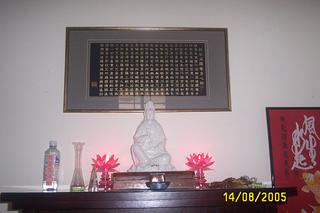
(our shrine at home where we do our Puja)
I guess, its up to up parents again - just as what the Ministers say when the schools cannot solve the problems - the parents needs to do their part.
K V
This morning while we were all waiting for Puja start a member from Buddhist center came up to the classes and instructed the teachers to "abandon" Puja, the classes elsewhere because there was a very important speaker in the center and there were just too many people attending the talk. A couple of the children's classes had give way for the audience to view a tv projection of the talk. The children's classes had to be "sacrificed".
A parent approached this adult and suggested that Puja must be conducted for the children. This parent also voiced his opinion that if Children's Puja is cancelled as it may send the wrong message to the children.
I agree with this parents and I generally feel that we will need to give attention to our children and give them the due respect. There is just too much of lip-service saying that we need to give attention to our children. Parents talk too much and it comes to making decisions, very commonly, children's needs are over-ruled. One of the last places I thought I would see this happen was in a Buddhist Center - but I guess it runs in our community ans society. I was upset because, have trying very hard find a connection for my children to the Buddhist teachings without being too imposing. I needed to let them have the space and fun to learn and appreciate for themselves.
I guess we will have to learn to live with it. I am just happy that we have opportunity to Puja together more regularly.
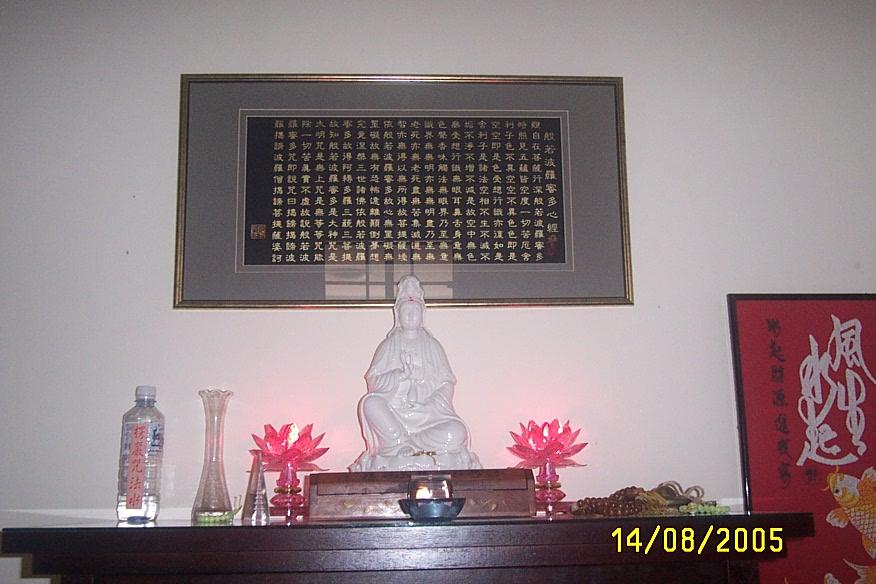
(our shrine at home where we do our Puja)
I guess, its up to up parents again - just as what the Ministers say when the schools cannot solve the problems - the parents needs to do their part.
K V
Seeing through the haze.....
The haze that has engulfed our city over the past couple of days has caused undue stress and worry for me and I guess for many parents as well. Although it seems that the situation is not too bad right now, I was affected in some ways and felt very uncomfortable with my chest giving occasional pain. Had to finally put on a mask. I later found out, the brother-in-law had the same problem.
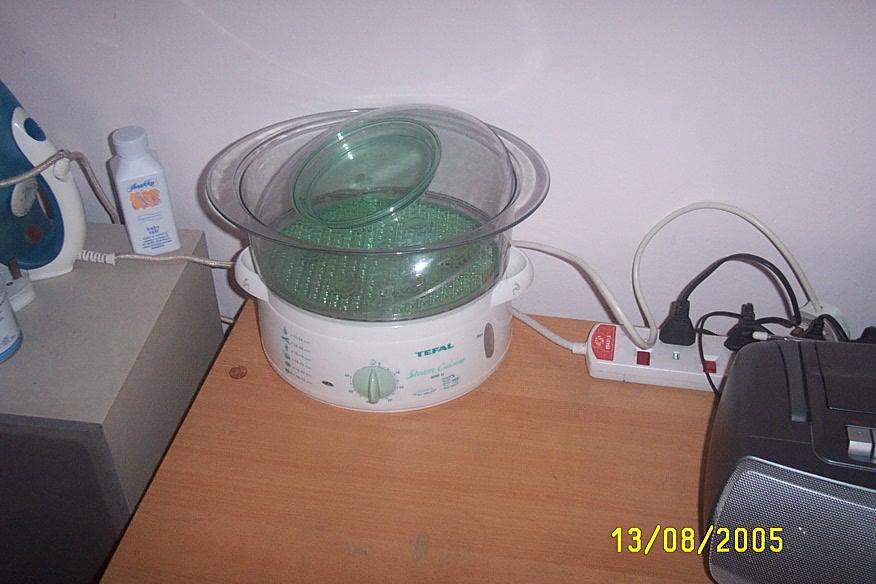 (our haze fighting machine)
What concerned me most was the effect on my family and children. After having heard a news report that asthma and breathing illness increased 150%, it worried me. I was calling back home almost every hour checking on my family and kids. My eldest daughter is potentially asthmatic and my one-year old son falls into the high risk category. Thank goodness they are fine. We tried all sort of stuff. My wife borrowed an air filter from her brother. We also told that "steaming" our rooms helped reduce the effects of the haze in our homes, which we did. I did it at my office as well. I think it worked. You should try it too.
While I was worried about the potential effect of the haze, I felt pretty helpless that there is nothing we can do about it. The thought that we cannot control things is pretty enhumbling, make one feels small and insignificant. Not sure how to deal with this yet but, right now living day by day through this hazy without any problems is top priority.
How did you deal with the haze situation?
K V
Tuesday, August 09, 2005
We remember....... how do we tell our children?
 Today, 3 days after the the first atomic bomb was dropped in Hiroshima 60 years ago, is the anniversary of the second atomic bomb was dropped over Nagasaki. As we remember the event which claimed over 150,000 lives within the span of 3 days, I was trying hard to educate my children on the effect of war.
I threw them a question, "what important world event happened this week 60 years ago". I told them to watch the news and find out for themselves. Their reply, at the end of the day was "Hiroshima!". My elder daughter could of course explain in some detail the historical detail. I on the otherhand tried to tried to insert the morals of war (rather the immorality) of war. I even managed to get them to watch (part of) the movie "Hiroshima" which detailed historically (at least that's what the CD cover claimed) the events leading up to the dropping of the atomic bombs which directly lead to the end of the second world war.
While watching the movie, my dad gently reminded me not to forget the incidents that happened before the atomic bomb was dropped - namely the atrocities the Japanese imperial army generated over the years. In Nanjing in China in 1937, the Japanese Imperial army captured Nanjing after grave atrocities were conducted. ABout 200,000 civilians were killed in the space of just 6 week. And throughout the Sino-Japanese war (1937-1945) over 7,000,000 Chinese civilians lost their lives. The damage and distruction by the atomic bomb pales in comparison to the atrocities of the Japanese Imperial Army over that period. One should not forget that the Americans came into the war with after November 1941 when the Japanese launched an air strike at Pearl Habour.
Yet, the challenge in educating our children is to teach non-violence is tough. There is not right and not wrong. Trying to tell tham that revenge is not the way and that war can be complicated affair.
After all this information communication over the past week, their response was a simple "okay, understand" and off they went to whatever they wanted to do - perhaps WW2 was too far away and cannot relate at all.
What are your thoughts and how did you talk about war with your children?
K V
Some references
http://www.bergen.org/AAST/Projects/ChinaHistory/rape.html (caution: graphic images)
http://en.wikipedia.org/wiki/Nanking_Massacre
http://users.rcn.com/mwhite28/ww2stats.htm (data & stats of casulties)
Subscribe to:
Posts (Atom)