In the (NST Nov 5, 2006, see below), it is heartening that Associate Professor Peter Knapp said with a local education, Malaysian students can get into any university in the world. But do we need someone to tell us something we already know? What would be interesting to know would - how many of the 35,000 students who took the test actually did well. I guess we will only know in early 2007, if you refer to the EAA Website.
Malaysian students have gone to world-class universities before and I am sure this will trend to continue. Surely do not need someone to tell us something we already know. What we would really like to see achieve is that more of our local student gain admission into world-class universities (and of course, return home after that).
Most importantly I feel would be the ability of our local universities to be world-class. It would really be good if someone could tell us that we are, at least, on the way there.
Click here to see the NST Report

INTERCONNECTIONS. Everything is connected, somehow.
Monday, November 06, 2006


20,000 Year Six Pupils Can't Read or Write Well: Part 2
In the recent newspaper article in the Star (Nov 5, 2006, see below for article). It is heartening to note that the CDC has actually gone ahead with the program to help Year 6 students to read and write well. While this effort is a major step ahead and I stand corrected that this is NOT an opportunity for someone's name and picture to appear in the papers but a good effort.
However, I would still like know what the long term plan of such action. It would good if we can address some of the following:
(a) What went wrong in the teaching approach that for five years from Year ONE to Year FIVE, if any, that arises this problem in Year SIX.
(b) Should such programs be introduced in, say, Year Three instead?
(c) Why is there no recoginition of learning disabilities, and effective ways be addressed them?
(d) What is the update on the pilot program to address in dyslexia - supposedly in 30 schools nationwide?
Time to keep moving forward.
Click here for News Article
K V
However, I would still like know what the long term plan of such action. It would good if we can address some of the following:
(a) What went wrong in the teaching approach that for five years from Year ONE to Year FIVE, if any, that arises this problem in Year SIX.
(b) Should such programs be introduced in, say, Year Three instead?
(c) Why is there no recoginition of learning disabilities, and effective ways be addressed them?
(d) What is the update on the pilot program to address in dyslexia - supposedly in 30 schools nationwide?
Time to keep moving forward.
Click here for News Article
K V
Tuesday, October 24, 2006
20,000 Year Six pupils can’t read or write well
It is heartening to know that the Education Ministry through its CDC (Curriculum Development Corporation) is attempting to tackle the literacy issue involving Primary 6 students. While, I think intensive teaching over a period of time a be good, continued efforts in early detection, intervention and support for students with learning disability is more important.
As I was writing this blog, I wanted to find out what were the activities carried out by the Ministry of Education (Malaysia) so far. I found out that in a article reported in the Dyslexia Association of Singapore a pilot program was suppose to have started by the Jabatan Pendidikan Khas which was to be implemented in 30 different schools nationwide by June. A check on the MOE website and the KPK wepsite - showed nothing of such an initiative. I wonder what happened. If anyone reading this knows anything about this initiative, please let me know.
I hope this news article is not just another reason to have someone's pictures or names appear in the newspaper [see article below] but a serious effort to ensure that students with learning disabilities are not left out.
KV
=====
Source: www.thestar.com.my
20,000 Year Six pupils can’t read or write well
Mahzan: ‘Such pupils are at risk of dropping out’
Monday October 23, 2006
20,000 Year Six pupils can’t read or write well
By KAREN CHAPMAN
PUTRAJAYA: About 20,000 Year Six pupils in schools have been identified as lacking in basic literacy skills and are currently undergoing an intensive two-month programme to help them. The number represents about 4% of 12-year-olds in schools who, after six years of primary schooling, are either very weak in reading and writing, maths or both.
“We are taking the matter seriously as such pupils are at risk of dropping out of the school system and can face a hard time continuing with their education or pursuing a career,” said Curriculum Development Centre (CDC) director Mahzan Bakar. He told The Star that the pupils were selected by their teachers based on their observation and the performance of the children in tests.
The intensive programme for them was conducted immediately after the Ujian Pencapaian Sekolah Rendah (UPSR) in September and they will sit for an evaluation test on Nov 15 to see how much they have learnt. In August, Education Ministry director-general Datuk Dr Ahamad Sipon announced that those yet to master basic literacy skills would receive help under the “Three Rs (Reading, Writing and Arithmetic) Programme” (Protim).
Mahzan said the CDC worked with teachers to create two modules to help the pupils in both national and national-type schools – one on reading and writing, and the other on arithmetic. “Protim is carried out full-time during school hours. The classes are small to ensure these pupils receive individual attention.”
In general, most schools have fewer than 10 pupils who have yet to grasp these basic skills, he added.
“Not all the identified pupils will have to sit in for these intensive classes. Some who have already grasped arithmetic skills would only need to attend reading and writing classes or vice versa while others who lack these three skills will attend the whole session,” he said an interview after a visit together with The Star to SK Sungai Ramal Dalam to observe a Protim class.
Asked why some pupils had yet to grasp the basic skills, Mahzan said some of them could have learning difficulties that had not been diagnosed.
He said Protim which would become an annual programme, just like the Early Intervention Class Programme for Reading and Writing (KIA2M) introduced in April this year for Year One pupils.
The ministry introduced KIA2M to ensure Year One pupils would not go through each level of primary schooling without being able to read and write.
As I was writing this blog, I wanted to find out what were the activities carried out by the Ministry of Education (Malaysia) so far. I found out that in a article reported in the Dyslexia Association of Singapore a pilot program was suppose to have started by the Jabatan Pendidikan Khas which was to be implemented in 30 different schools nationwide by June. A check on the MOE website and the KPK wepsite - showed nothing of such an initiative. I wonder what happened. If anyone reading this knows anything about this initiative, please let me know.
I hope this news article is not just another reason to have someone's pictures or names appear in the newspaper [see article below] but a serious effort to ensure that students with learning disabilities are not left out.
KV
=====
Source: www.thestar.com.my
20,000 Year Six pupils can’t read or write well
Mahzan: ‘Such pupils are at risk of dropping out’
Monday October 23, 2006
20,000 Year Six pupils can’t read or write well
By KAREN CHAPMAN
PUTRAJAYA: About 20,000 Year Six pupils in schools have been identified as lacking in basic literacy skills and are currently undergoing an intensive two-month programme to help them. The number represents about 4% of 12-year-olds in schools who, after six years of primary schooling, are either very weak in reading and writing, maths or both.
“We are taking the matter seriously as such pupils are at risk of dropping out of the school system and can face a hard time continuing with their education or pursuing a career,” said Curriculum Development Centre (CDC) director Mahzan Bakar. He told The Star that the pupils were selected by their teachers based on their observation and the performance of the children in tests.
The intensive programme for them was conducted immediately after the Ujian Pencapaian Sekolah Rendah (UPSR) in September and they will sit for an evaluation test on Nov 15 to see how much they have learnt. In August, Education Ministry director-general Datuk Dr Ahamad Sipon announced that those yet to master basic literacy skills would receive help under the “Three Rs (Reading, Writing and Arithmetic) Programme” (Protim).
Mahzan said the CDC worked with teachers to create two modules to help the pupils in both national and national-type schools – one on reading and writing, and the other on arithmetic. “Protim is carried out full-time during school hours. The classes are small to ensure these pupils receive individual attention.”
In general, most schools have fewer than 10 pupils who have yet to grasp these basic skills, he added.
“Not all the identified pupils will have to sit in for these intensive classes. Some who have already grasped arithmetic skills would only need to attend reading and writing classes or vice versa while others who lack these three skills will attend the whole session,” he said an interview after a visit together with The Star to SK Sungai Ramal Dalam to observe a Protim class.
Asked why some pupils had yet to grasp the basic skills, Mahzan said some of them could have learning difficulties that had not been diagnosed.
He said Protim which would become an annual programme, just like the Early Intervention Class Programme for Reading and Writing (KIA2M) introduced in April this year for Year One pupils.
The ministry introduced KIA2M to ensure Year One pupils would not go through each level of primary schooling without being able to read and write.
Monday, October 23, 2006
That Time fo the Year Again - the THES World University Ranking 2005
This time, University Malaysia (UM) not only did not improve its overall ranking, Universiti Kebangsaan Malaysia (UKM) has gotten a better ranking than UM! As usual the politicians will have the first say but I think Professor Emeritus Datuk Khoo Kay Kim pointed out several points (below) which I think needs some serious consideration :
There is now overemphasis on the need for graduates to get
jobs. We are not encouraging them to be self-employed.
Universities are asked to produce employable graduates, not those
who can stand on their own feet or make critical decisions. If this is
the case, we will not be able to compete with Western countries.
Over the years, we have also adopted a different philosophy. Now
there is a tendency not to fail a student. If we produce graduates
who are half-educated, what will they be able to do outside?
In the early days of UM, only about 25 per cent of students would
pass, now it is almost 100 per cent. Of the 30 students who made
up the first batch of UM’s engineering course, only five passed.
Full article if the interview is currently available at http://www.nst.com.my/Current_News/nst/Monday/National/20061016084710/Article/index_html
This statement this about the decline in standard and the passing level that has gone down got me thinking about the causes of this decline. While politicians argue over funding, argue over the method the THES used in its evaluation, etc. My thought is simple....."garbage in, garbage out" - The quality of the students entering local universitiies is are fed in from our schools - where there from 7 years ols (Primary 1) are basically "spoon-fed", not thought to think and above all very exam orientated.
Perhaps it is time we look at (seriously look at) the entire primary and secondary education system. Our Minister of Education has promised us "blueprint" for education reform. Sometime in July 2006 Datuk Seri Hishammuddin Hussein stated that an ambitious and mammoth Education Blueprint "is a step away from being unveiled". I have not seen it anywhere.
The objective of the Blueprint is to meet the goals highlighted in the 9th Malaysia Plan - rejuvenate national schools, reduce the knowledge gap between rural and urban areas, strengthen the quality of the curriculum and uplift the teaching profession. On top of that the Ministry wants to ensure that "there are no more dropouts, students who cannot read, write or count, and those who have no information technology and communication (ICT) skills."
In the recent National Budget announcements, I have shared my thoughts in FamilyPlace - perhaps it is time for our Honourable Minister to spend more time look indepth into our education system and spend less time waving kris' and engage in unnecessary, non-education related activities.
jobs. We are not encouraging them to be self-employed.
Universities are asked to produce employable graduates, not those
who can stand on their own feet or make critical decisions. If this is
the case, we will not be able to compete with Western countries.
Over the years, we have also adopted a different philosophy. Now
there is a tendency not to fail a student. If we produce graduates
who are half-educated, what will they be able to do outside?
In the early days of UM, only about 25 per cent of students would
pass, now it is almost 100 per cent. Of the 30 students who made
up the first batch of UM’s engineering course, only five passed.
Full article if the interview is currently available at http://www.nst.com.my/Current_News/nst/Monday/National/20061016084710/Article/index_html
This statement this about the decline in standard and the passing level that has gone down got me thinking about the causes of this decline. While politicians argue over funding, argue over the method the THES used in its evaluation, etc. My thought is simple....."garbage in, garbage out" - The quality of the students entering local universitiies is are fed in from our schools - where there from 7 years ols (Primary 1) are basically "spoon-fed", not thought to think and above all very exam orientated.
Perhaps it is time we look at (seriously look at) the entire primary and secondary education system. Our Minister of Education has promised us "blueprint" for education reform. Sometime in July 2006 Datuk Seri Hishammuddin Hussein stated that an ambitious and mammoth Education Blueprint "is a step away from being unveiled". I have not seen it anywhere.
The objective of the Blueprint is to meet the goals highlighted in the 9th Malaysia Plan - rejuvenate national schools, reduce the knowledge gap between rural and urban areas, strengthen the quality of the curriculum and uplift the teaching profession. On top of that the Ministry wants to ensure that "there are no more dropouts, students who cannot read, write or count, and those who have no information technology and communication (ICT) skills."
In the recent National Budget announcements, I have shared my thoughts in FamilyPlace - perhaps it is time for our Honourable Minister to spend more time look indepth into our education system and spend less time waving kris' and engage in unnecessary, non-education related activities.
Friday, May 26, 2006
Humans are Mammals?
If you look at how we respond to 2 film you will understand it.
Firstly, The Da Vinci Code - home many people actually saw the movie before critizing the it? Protests was lodge even before the movie was premiered! Are you one of them who join the chorus of protest (or support)?

Closer to home, there is "Lelaki Komunis Terakhir". Political leaders critized and called to have it banned. How many people have seen it? It not premiered yet. Those who were invited to view in private, had different opinions.

So, are we humans are or we humans.
Firstly, The Da Vinci Code - home many people actually saw the movie before critizing the it? Protests was lodge even before the movie was premiered! Are you one of them who join the chorus of protest (or support)?
Closer to home, there is "Lelaki Komunis Terakhir". Political leaders critized and called to have it banned. How many people have seen it? It not premiered yet. Those who were invited to view in private, had different opinions.
So, are we humans are or we humans.
Tuesday, May 23, 2006
No words......
There are no words to express my thoughts about the murder that shocked our nation. Ijust cannot imagine what goes through the killer's mind. What more in the victim's mind?
I just feel so sad and grief for the parents and family of Ho Ping. These words came to my mind and I dedicate this prayer to those who grief....

"Anicca vata sankhara Uppada vaya dhammino
I just feel so sad and grief for the parents and family of Ho Ping. These words came to my mind and I dedicate this prayer to those who grief....

"Anicca vata sankhara Uppada vaya dhammino
Uppajjitva nirijjhanti Tesam vupasamo sukho.
Dukkha vata sankhara Uppada vaya dhammino
Uppajjitva nirujjhanti Tesam vupasamo sukho.
Anatta vata sankhara Uppada vaya dhammino
Uppajjitva nirujjhanti Tesam vupasamo sukho"
KV
Tuesday, March 28, 2006
Where do clever Malaysians go? (Part 3)
I am not sure that the going to any school in Malaysia would be the solution for this young boy while the education system is not changed. What I am really interested in are the programmes the Education Ministry has organize, in which the child is not forced into it. I feel this situation the the best chance for our education system to be reviewed and revised to accomodate smarter kids or kids with different needs.
This young boy has been profiled as a maths whiz kid, but there are may more children with individual capabilities and intelligences which does not fit the learning environment in the schools. Hence, they find lessons boring and likely to end up falling to the back of their class. Many speakers have spoken about this including Prof Chiam Heng Keng of University Malaya.
Source http://thestar.com.my/news/story.asp?file=/2006/3/25/nation/13773414&sec=nation
The Star Online > Nation
Saturday March 25, 2006
Whiz kid can go to school of parents’ choice
PETALING JAYA
Seven-year-old Adi Putra Abdul Ghani (pic), who fascinated Malaysians with his ability to solve Additional Mathematics problems, can study at any school of his parents’ choice.
Education Minister Datuk Seri Hishammuddin Tun Hussein said yesterday: “The ministry has organised some programmes for him but we are not forcing anyone to do it. “If his father wants him to change schools, I have no problems with that. Just send in the application and I will approve it.”
Abdul Ghani Abdul Wahab, 48, had said on Thursday he would appeal to the Education Ministry to allow his son to study at Sekolah Islam Antarabangsa or at a private school that would allow him to have a more flexible education.
This young boy has been profiled as a maths whiz kid, but there are may more children with individual capabilities and intelligences which does not fit the learning environment in the schools. Hence, they find lessons boring and likely to end up falling to the back of their class. Many speakers have spoken about this including Prof Chiam Heng Keng of University Malaya.
Source http://thestar.com.my/news/story.asp?file=/2006/3/25/nation/13773414&sec=nation
The Star Online > Nation
Saturday March 25, 2006
Whiz kid can go to school of parents’ choice
PETALING JAYA
Seven-year-old Adi Putra Abdul Ghani (pic), who fascinated Malaysians with his ability to solve Additional Mathematics problems, can study at any school of his parents’ choice.
Education Minister Datuk Seri Hishammuddin Tun Hussein said yesterday: “The ministry has organised some programmes for him but we are not forcing anyone to do it. “If his father wants him to change schools, I have no problems with that. Just send in the application and I will approve it.”
Abdul Ghani Abdul Wahab, 48, had said on Thursday he would appeal to the Education Ministry to allow his son to study at Sekolah Islam Antarabangsa or at a private school that would allow him to have a more flexible education.
Friday, March 24, 2006
Where do clever children in Malaysia go? (Part 2)
It is interesting to read this article in the STAR (www.thestar.com.my) this morning - after I posted my blog yesterday. We have a so called system to make not-so smart people smarter. Sad to say the system also makes the smart people be less smart. Out education system is a funnel pushing people of different intelligences into on "one size, fit all" environment. I feel this young boy should be given the change to explore maths in it higher, without subjecting him to an extremely different social environment, only than will he be able to go beyond is current level - a very tall order indeed.
It will be interesting to see how this situation develops into an action plan. (Reade the full STAR article belo)

The Star Online > Nation (Source: http://www.thestar.com.my/news/story.asp?file=/2006/3/24/nation/13762330&sec=nation)
Friday March 24, 2006
Genius finds school boring
By CHRISTINA KOH
IPOH: Young maths whiz Adi Putra Abdul Ghani, who fascinated Malaysians with his ability to solve Additional Mathematics problems, faces the possibility of being thrown out of his primary school.
The parents of the seven-year-old boy have received show-cause letters from his school, SK Jalan Matang Buluh in Bagan Serai, warning them that he could be expelled for cutting classes too often.
His mother Serihana Elias, a former teacher, said her son was reluctant to go to school because he was bored with the basic syllabus of reading, writing and counting (mengira) laid down by the Education Ministry.
Adi Putra, who could read newspapers by the age of four, had told his mother that he would prefer studying at a school like Sekolah Islam Antarabangsa in Kuala Lumpur.
There, she said, he could learn languages like Japanese, French, English, Chinese as well as tahfiz al-Quran studies. They were in the process of enrolling their son there, Serihana said.
“I’m disappointed that SK Jalan Matang Buluh issued the warning letter to my son in February. Some might think we are exploiting Adi Putra, but he himself said that he was bored in school,” she told reporters here yesterday.
His father Abdul Ghani Abdul Wahab, 48, said he would appeal to the Education Ministry to allow his son to study at Sekolah Islam Antarabangsa or a private school that would allow him to have a more flexible education.
It will be interesting to see how this situation develops into an action plan. (Reade the full STAR article belo)

The Star Online > Nation (Source: http://www.thestar.com.my/news/story.asp?file=/2006/3/24/nation/13762330&sec=nation)
Friday March 24, 2006
Genius finds school boring
By CHRISTINA KOH
IPOH: Young maths whiz Adi Putra Abdul Ghani, who fascinated Malaysians with his ability to solve Additional Mathematics problems, faces the possibility of being thrown out of his primary school.
The parents of the seven-year-old boy have received show-cause letters from his school, SK Jalan Matang Buluh in Bagan Serai, warning them that he could be expelled for cutting classes too often.
His mother Serihana Elias, a former teacher, said her son was reluctant to go to school because he was bored with the basic syllabus of reading, writing and counting (mengira) laid down by the Education Ministry.
Adi Putra, who could read newspapers by the age of four, had told his mother that he would prefer studying at a school like Sekolah Islam Antarabangsa in Kuala Lumpur.
There, she said, he could learn languages like Japanese, French, English, Chinese as well as tahfiz al-Quran studies. They were in the process of enrolling their son there, Serihana said.
“I’m disappointed that SK Jalan Matang Buluh issued the warning letter to my son in February. Some might think we are exploiting Adi Putra, but he himself said that he was bored in school,” she told reporters here yesterday.
His father Abdul Ghani Abdul Wahab, 48, said he would appeal to the Education Ministry to allow his son to study at Sekolah Islam Antarabangsa or a private school that would allow him to have a more flexible education.
Where do clever children in Malaysia go?
A thought just came to my mind as I was reading the comments and postings on education. If a child is "weak" in maths, there are tuition centers, enrichment programs such as Enopi, Kumon... lots more. But what is your child is smart, good in maths and really LOVE maths? There's probably no where to go to to learn beyond his/her level. Ever wondered why, there are more engineers than mathematicians in this country. Children with deep interest in maths, have no avenue to go beyond their peers.
Another reason why we need to relook at our education system - not just revamp of examinations systems.
Where do clever children in Malaysia go? Trinity College in Melbourne could be a start.
Another reason why we need to relook at our education system - not just revamp of examinations systems.
Where do clever children in Malaysia go? Trinity College in Melbourne could be a start.
Thursday, March 16, 2006
Our Education System - what's happening?
What's happening out there?
Are our headmasters corrupted (in Chinese Schools) as alleged by a certain Mr Ong Koh Hou who offers a reward of RM500,000 for information and evidence of corruption by headmasters in Chinese primary schools and the Federation of Chinese School Headmasters (FCSH) is fighting back...the saga continues.
"A Chinese primary school is offering places to the highest bidders, starting with a minimum donation of RM300." That was the first sentence in a report in the New Straits Times on Mar 9, 2006. Some parents have told me that more than one (especially the more popular ones) gives greater consideration to parents to makes donations to the school. Well, I guess the basic rule of supply and demand rules.
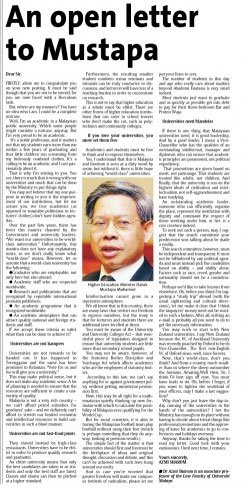
Just when we think our kids are way past the primary level and we are considering which local university to send our kids to, Dr Azmi Sharom, an associate professor of the Law Faculty of University Malays wrote an open letter to The Star on March 11, 2006 expressing what some parents felt about our local universities.

Recently we were all told how good our form 5 students are with an increase of 43% students scoring straight 1As, 945 students scored straight A1s, 283 more than last year. Nevermind if you have 15A1s + 1A2 does not qualify you as a top student (this student has only a 95% A1s). It is interesting to note why are more and more students are scoring straight As compared to 10-20 years ago. I hope it is not a situation of "shiok sendiri" (self gratification).


Its seems okay when ONLY one student tried to kill herself by jumping off the third storey of her school building because she was not too pleased with her results. I hope this not a sign of things to come. Can we tell our children it's okay, that academic achievement is not the only defining criteria of success?

Congrats to our Education Minister daughter, Nasha Alyssa she scored 9As in SPM examination. She had scored 8As in PMR and 5As in UPSR. If you do not know yet, she is now studying at Trinity College in Melbourne doing her foundation studies). What happened to out local 6th Form and local universities.
So, if you want to know what's happening out there in our education system, take the cue from our Education Datuk Seri Hishammuddin Tun Hussein.
I am seriously considering looking for a second job to prepare my kids to go to the Trinity College in Melbourne.
Are our headmasters corrupted (in Chinese Schools) as alleged by a certain Mr Ong Koh Hou who offers a reward of RM500,000 for information and evidence of corruption by headmasters in Chinese primary schools and the Federation of Chinese School Headmasters (FCSH) is fighting back...the saga continues.
"A Chinese primary school is offering places to the highest bidders, starting with a minimum donation of RM300." That was the first sentence in a report in the New Straits Times on Mar 9, 2006. Some parents have told me that more than one (especially the more popular ones) gives greater consideration to parents to makes donations to the school. Well, I guess the basic rule of supply and demand rules.
Just when we think our kids are way past the primary level and we are considering which local university to send our kids to, Dr Azmi Sharom, an associate professor of the Law Faculty of University Malays wrote an open letter to The Star on March 11, 2006 expressing what some parents felt about our local universities.
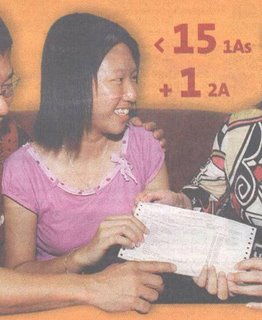
Recently we were all told how good our form 5 students are with an increase of 43% students scoring straight 1As, 945 students scored straight A1s, 283 more than last year. Nevermind if you have 15A1s + 1A2 does not qualify you as a top student (this student has only a 95% A1s). It is interesting to note why are more and more students are scoring straight As compared to 10-20 years ago. I hope it is not a situation of "shiok sendiri" (self gratification).

Its seems okay when ONLY one student tried to kill herself by jumping off the third storey of her school building because she was not too pleased with her results. I hope this not a sign of things to come. Can we tell our children it's okay, that academic achievement is not the only defining criteria of success?

Congrats to our Education Minister daughter, Nasha Alyssa she scored 9As in SPM examination. She had scored 8As in PMR and 5As in UPSR. If you do not know yet, she is now studying at Trinity College in Melbourne doing her foundation studies). What happened to out local 6th Form and local universities.
So, if you want to know what's happening out there in our education system, take the cue from our Education Datuk Seri Hishammuddin Tun Hussein.
I am seriously considering looking for a second job to prepare my kids to go to the Trinity College in Melbourne.
Saturday, March 11, 2006
An open letter to Mustapa - THE STAR Saturday March 11, 2006
THE STAR Saturday March 11, 2006
An open letter to Mustapa
Dear Sir,
Firstly, allow me to congratulate you on your new posting. It must be said though that you are not to be envied, for you are now faced with a Herculean task.
But, where are my manners? You have no idea who I am. I could be a complete nutcase.
Well, I’m an academic in a Malaysian public university. Which some people might consider a nutcase, anyway. But I’m very proud to be an academic.
It’s a noble profession, and it matters not that my students earn more than me within a few years of graduating and that little children run screaming from my hideously outdated clothes. It’s a calling to be an academic, and I care passionately about it.
That is why I’m writing to you. You see, there is much that is wrong with our universities and much that can be done by the Ministry to put things right.
You may not believe that my one purpose in writing to you is the improvement of our institutions, but let me assure you, we true academics (as opposed to wannabe politicians in lecturers’ clothes) don’t have hidden agendas.
Over the past few years, there has been this mantra chanted by the Government and university leaders: “We want our universities to be world-class universities.” Unfortunately, this mantra does not have any explanatory notes, so we don’t really know what “world-class” means. However, let us assume that a world-class university has the following:
- Graduates who are employable, not only here but also abroad;
- Academic staff who are respected worldwide;
- Research and publications that are recognised by reputable international journals/publishers;
- An academic programme that is recognised worldwide;
- An academic atmosphere that can attract quality national and foreign students and staff.
If we accept these criteria as valid, what then can be done to achieve it?
Universities are not hampers
Universities are not rewards to be handed out. It has happened in Terengganu and the same has been promised to Kelantan. “Vote for us and we will give you a university.”
This may make political sense, but it does not make any academic sense. A lot of planning is needed to ensure that the resources are sufficient to create a university of quality.
Malaysia is not a very rich country – we can’t afford petrol subsidies, for goodness’ sake – and we definitely can’t afford to stretch our limited economic and intellectual resources to build universities in such a blasé manner.
Universities are not fast-food joints
They should instead be high-class restaurants. Universities have to be elitist in order to produce quality research and graduates.
An elitist university means that only the best candidates are taken in as students and only the best staff are hired. Classes and exams can then be pitched at a higher standard.
Furthermore, the resulting smaller student numbers mean seminars and tutorials can be truly conducive to discussions, and lecturers will have less of a teaching burden in order to concentrate on research.
This is not to say that higher education as a whole must be elitist. There are other forms of higher education institutions that can cater to school leavers who don’t make the cut, such as polytechnics and community colleges.
If you love your universities, you must set them free
Academics and students must be free to think and to express themselves.
Yes, I understand that this is Malaysia and freedom is seen as a dirty word by some, but without it, there is little hope of achieving “world-class” universities.
Intellectualism cannot grow in a repressive atmosphere.
We all know that in this country, there are many laws that restrict our freedom to express ourselves, but the irony is that for lecturers and students there are additional laws levelled at them.
You must be aware of the University and University Colleges Act – that wonderful piece of legislation designed to ensure that university students are little more than secondary school pupils.
You may not be aware, however, of the Statutory Bodies Discipline and Surcharge Act which affects academics who are the employees of statutory bodies.
According to this law, we can’t say anything for or against government policy without getting ministerial permission first.
Now, this may be all right for a mathematician quietly thinking up new formulae with which to calculate the possibility of Malaysia ever qualifying for the World Cup.
But for social scientists, it is akin to having the Malaysian football team play football without using their feet (which is perhaps something that they do anyway, looking at previous results).
The simple fact of the matter is that universities should first and foremost be the birthplace of ideas and original thought, discussion and debate, and this can’t be achieved with such laws hung around our necks.
And in case you’re worried that greater freedom will make our campuses hotbeds of radicalism, please let me put your fears to rest.
The number of students in this day and age who really care about matters beyond Akademi Fantasia is very small indeed.
Most students just want to graduate and as quickly as possible get into debt to pay for their three-bedroom flat and Proton Waja.
Universities need Mandelas
If there is one thing that Malaysian universities need, it is good leadership. And by a good leader, I mean a Vice-Chancellor who has the qualities of an outstanding intellectual, manager and diplomat, who can ensure that academic principles are paramount, not political expediency.
That promotions are given based on merit, not patronage. That students are treated like adults, not children. And finally, that the university is run on the highest ideals of civilisation and intellectualism, not self-aggrandisement and base toadying.
An outstanding academic leader, someone who can efficiently organise the place, represent the institution with dignity and command the respect of those working under him, or her, is a rare creature indeed.
To seek out such a person, may I suggest that the search committee your predecessor was talking about be made a reality.
This search committee, however, must be independent and transparent. It must not be hiHndered by any political agenda and must instead pick the candidates based on ability – and ability alone. Factors such as race, creed, gender and nationality should not be a consideration.
Perhaps we’d like to take lessons from elsewhere. Oh, before you think I’m suggesting a “study trip” abroad (with the usual sightseeing and cultural diversions), let me make it clear that I think the taxpayers’ money need not be wasted in such a fashion. After all, writing an e-mail is probably all you need to do to get the necessary information.
You may wish to start with New Zealand universities. I say New Zealand because the VC of Auckland University was recently poached by Oxford to be its Vice-Chancellor. The first non-English VC of Oxford since, well, since forever.
Now, that’s world-class, don’t you think? And from a country much smaller than us where the sheep outnumber the humans. Amazing.Well then, Sir, I think I’d best sign off now. You must have loads to do. Oh, before I forget, if you want to lighten the workload of your officers, may I make a last suggestion?
Why don’t you just leave the day-to-day running of the universities in the hands of the universities? I bet the Ministry has enough on its plate without having to decide about trivial things like professorial promotions and the approving of leave for academics to go to conferences and holidays overseas.
Anyway, thanks for taking the time to read my letter. Good luck with your endeavours. Until next time, I remain,
Yours sincerely,
AZMI SHAROM
Dr Azmi Sharom is an associate professor of the Law Faculty of Universiti Malaya
Sunday, March 05, 2006
Sunday School today
It has been a challenge trying to talk about Buddhism to kids in my Sunday School class who (most of them) did not want to there in the first place. Their parents of course decided that Sunday Dharma School was something good for them. It has been a struggle over the past 2 months to try to understand and tune into the frequency of the students aged between 15 - 21 years.
I personally felt that I had an interesting session this morning. I felt I could connect with (at least a couple) of the students of my class. I felt I got some of the students thinking about their actions, their lives and what they really want.
More importantly, this morning's session today was a reminder for me, a reminder that the life of the Buddha is not just an exercise in religious history. It is reminder for me that the Buddha is alive and that his spiritual journey mirrors my own spiiritual journey and that I must strive continue to look inwards, not to forget my friends and famil as Kalyana Mitrata is the whole of spiritual practice.
I do hope some of my students share similar thoughts with me and appreciate the inherent buddha-citta.
Saturday, March 04, 2006
spiritual peace at home
At times of difficulty, I search for peace, our family Guanyin Shrine is a refuge.

The Prajnaparamita Heart Sutra, reminds me of the trancient nature of all things including suffering and difficulties. The offering of flowers is a physical reminder.
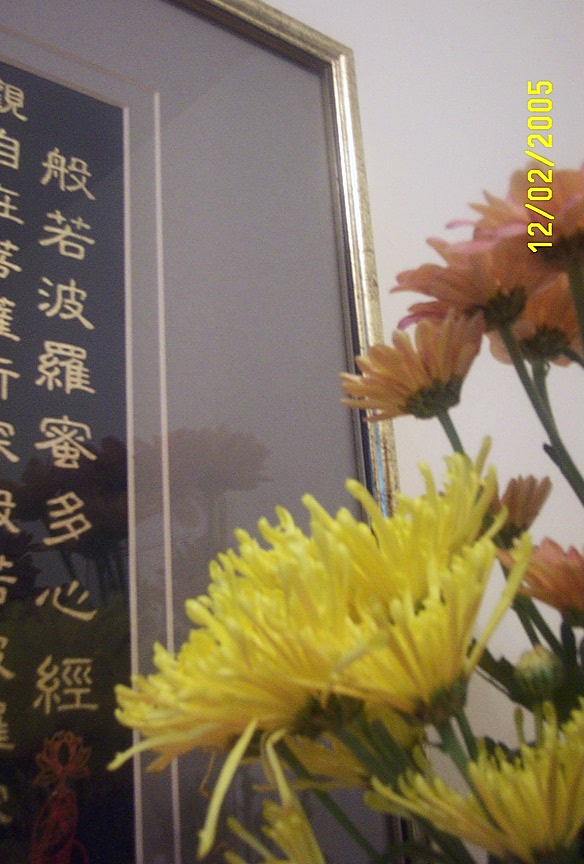
sometimes the little things in life counts....................

Flame becomes a meditation object of impermenace, wisdom and strength

May you have peace in you heart, no matter what the situation.
Sabbe Satta Sukhi Hontu!
KV
Sabbe Satta Sukhi Hontu!
KV

Sunday, February 12, 2006
Are Our Kids Today Spoilt?
In a conversation with close friend recently, he lemented about how his 19-year old son ask his mum to buy lunch for him despite the fact that he has his own car, he had not been home since the previous day. To make things worse, my friend and his wife were busy that morning. In respose to the ninteen year old's request the mother began to dash off to get lunch while the father felt that the young could and should go get his own food. As simple as this incident may be it triggered an arguement between the couple.
My friend further lemented that despite having bought his son a car. The son complain - to the mother - that the car is no good and he wished to have another better one. The car he has is an older Wira. A couple of days ago I visied my sister and spotted that her 15 year old daughter had a new hair do. She calls it rebonding (something that no matter how hard I try, I can never understand what it is). It was done at a hhigh-end salon and costed RM 360 to the shock of her mother and I. Again the father thinks it's just a few ringgit hair do at the neighbour salon. These events prompts us to think about the past and of "those days" back then when things were different. My friend with the 19 year old son, recalled his childhood days where he had to help his father work just to earn every meal each day. Life was tough. When he managed to get into university, his father only provided him with RM 450 year for fees and he had to work is way through and support himself on all other necessary expenses. I am sure most of us have such stories to tell. Some will argue that we live in different times from our parents and their parents as well. Perhaps they are right. As a parent I am of the opinion that our children do not necessarily need to endure the same kind of hardship we or our own parents have endured because times are different. So, how do we draw the line. Should our kids do laundry? We did it. Only now, there is the washing machine. Should we have our kids involved in housework and chores? Then again there are maids. Some parents have argued with me that the kids can make better use of their time to do and learn things, etc, etc. But how many children do we know turn off the television when they have free time? How should we give them pocket money and help them realize the value of money?
My friend further lemented that despite having bought his son a car. The son complain - to the mother - that the car is no good and he wished to have another better one. The car he has is an older Wira. A couple of days ago I visied my sister and spotted that her 15 year old daughter had a new hair do. She calls it rebonding (something that no matter how hard I try, I can never understand what it is). It was done at a hhigh-end salon and costed RM 360 to the shock of her mother and I. Again the father thinks it's just a few ringgit hair do at the neighbour salon. These events prompts us to think about the past and of "those days" back then when things were different. My friend with the 19 year old son, recalled his childhood days where he had to help his father work just to earn every meal each day. Life was tough. When he managed to get into university, his father only provided him with RM 450 year for fees and he had to work is way through and support himself on all other necessary expenses. I am sure most of us have such stories to tell. Some will argue that we live in different times from our parents and their parents as well. Perhaps they are right. As a parent I am of the opinion that our children do not necessarily need to endure the same kind of hardship we or our own parents have endured because times are different. So, how do we draw the line. Should our kids do laundry? We did it. Only now, there is the washing machine. Should we have our kids involved in housework and chores? Then again there are maids. Some parents have argued with me that the kids can make better use of their time to do and learn things, etc, etc. But how many children do we know turn off the television when they have free time? How should we give them pocket money and help them realize the value of money?
The real challenge will really be how are we encupsulate these experiences from ourselves and our fore-fathers, transforming them to values so as our children can appreciate and they themselves can internalize, integrate with their own experiences, moulding them to be better people.
Something to think about.
KV
Something to think about.
KV
Subscribe to:
Posts (Atom)