I was in KLCC Suria recently with my 3 children - including my youngest one year old son. My wife was away and I thought I could go hang out with the kids. I packed the diapers, the feeding bottles, change of clothings, milk...the works for my son. My daughters could manage as they are already eight and nine.
After several hours there, I realized that I had to change my son's diapers. He did his "big business". I followed the sign which was suppose to lead me to a diaper changing room. There was just one problem - ALL such rooms are in the WOMEN's toilet! I went over to the "premium toilet" - you are suppose to pay RM2 to use the toilet but the only diaper changing room is in the Women's room.
I started to panic as my boy was starting to smell ... you can imagine the rest. I needed to go change and clean this kid up - desperately! While there were some these attempts by the cleaners to help me none of them worked:
1. Move all the ladies out of the toilet while I go change my little boy. Of course this was difficult and the ladies did not cooperate.
2. One of the cleaning ladies decided to offer herself to take my son and change him for me. After all the horror stories of children getting kidnapped in shopping centers, I was not about the take a chance.
I was growing frustrated and I began to wonder what KLCC was thinking when they designed the building. How do they see Fathers and their role? Did they expect mothers / a lady to company men with their children everytime they want to take children along?
Fortunately for me one of the staff told me that there is such a room - for fathers - in the baby section of Isetan. I finally got to the room and changed my son's diapers. Even then - most of the time (almost) its all ladies inthe room.
I finally got my son cleaned up.
I visited ALAMANDA and it was the total opposite - there their facilities were complete and babies with their fathers could enter and do what needs to be done asap.
I hope the Suria KLCC will really make such facilities and really care for their customers.

INTERCONNECTIONS. Everything is connected, somehow.
Sunday, September 25, 2005


Tuesday, August 23, 2005
How do you make time?
I am just wondering how as busy fathers, make time for your children and family? I am in a career transition period now and at the back of my mind I have this thoughts, "now, i will have more time with my family". But I am concern it is not the case - at least, not my my standards.
If you are working on your own, will you have the flexibility of you time. True or false? If you are working for others, you may less time. True or false?
How do you balance and manage?
Care to share some thoughts?
K V
If you are working on your own, will you have the flexibility of you time. True or false? If you are working for others, you may less time. True or false?
How do you balance and manage?
Care to share some thoughts?
K V
Sunday, August 14, 2005
How important are our children?
Just got back from Sunday Dharma School today. Finally my kids have found a Sunday Dharma School they enjoy, could understand and connect with. They have even enjoyed Puja and have on their own initiated daily Puja sessions at home. I even started to join in their Sunday School Puja.
This morning while we were all waiting for Puja start a member from Buddhist center came up to the classes and instructed the teachers to "abandon" Puja, the classes elsewhere because there was a very important speaker in the center and there were just too many people attending the talk. A couple of the children's classes had give way for the audience to view a tv projection of the talk. The children's classes had to be "sacrificed".
A parent approached this adult and suggested that Puja must be conducted for the children. This parent also voiced his opinion that if Children's Puja is cancelled as it may send the wrong message to the children.
I agree with this parents and I generally feel that we will need to give attention to our children and give them the due respect. There is just too much of lip-service saying that we need to give attention to our children. Parents talk too much and it comes to making decisions, very commonly, children's needs are over-ruled. One of the last places I thought I would see this happen was in a Buddhist Center - but I guess it runs in our community ans society. I was upset because, have trying very hard find a connection for my children to the Buddhist teachings without being too imposing. I needed to let them have the space and fun to learn and appreciate for themselves.
I guess we will have to learn to live with it. I am just happy that we have opportunity to Puja together more regularly.
(our shrine at home where we do our Puja)
I guess, its up to up parents again - just as what the Ministers say when the schools cannot solve the problems - the parents needs to do their part.
K V
This morning while we were all waiting for Puja start a member from Buddhist center came up to the classes and instructed the teachers to "abandon" Puja, the classes elsewhere because there was a very important speaker in the center and there were just too many people attending the talk. A couple of the children's classes had give way for the audience to view a tv projection of the talk. The children's classes had to be "sacrificed".
A parent approached this adult and suggested that Puja must be conducted for the children. This parent also voiced his opinion that if Children's Puja is cancelled as it may send the wrong message to the children.
I agree with this parents and I generally feel that we will need to give attention to our children and give them the due respect. There is just too much of lip-service saying that we need to give attention to our children. Parents talk too much and it comes to making decisions, very commonly, children's needs are over-ruled. One of the last places I thought I would see this happen was in a Buddhist Center - but I guess it runs in our community ans society. I was upset because, have trying very hard find a connection for my children to the Buddhist teachings without being too imposing. I needed to let them have the space and fun to learn and appreciate for themselves.
I guess we will have to learn to live with it. I am just happy that we have opportunity to Puja together more regularly.
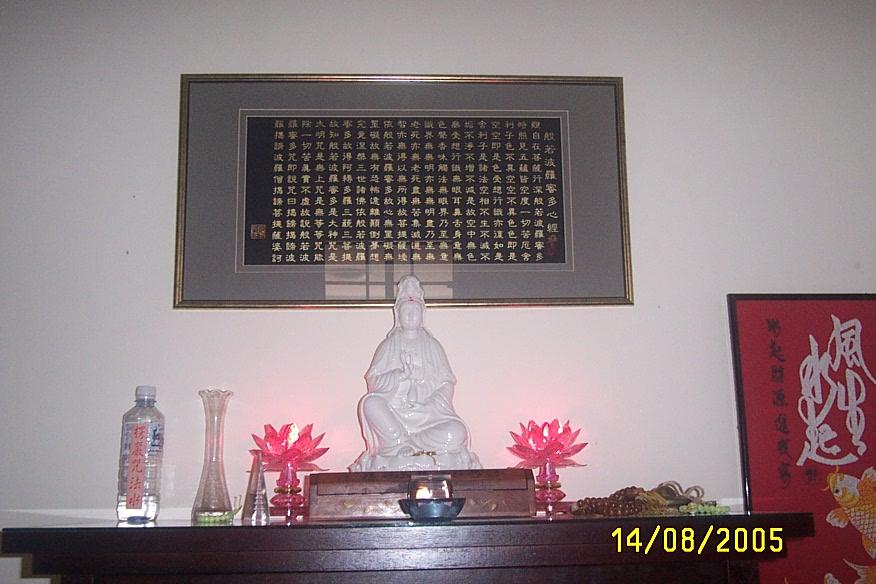
(our shrine at home where we do our Puja)
I guess, its up to up parents again - just as what the Ministers say when the schools cannot solve the problems - the parents needs to do their part.
K V
Seeing through the haze.....
The haze that has engulfed our city over the past couple of days has caused undue stress and worry for me and I guess for many parents as well. Although it seems that the situation is not too bad right now, I was affected in some ways and felt very uncomfortable with my chest giving occasional pain. Had to finally put on a mask. I later found out, the brother-in-law had the same problem.
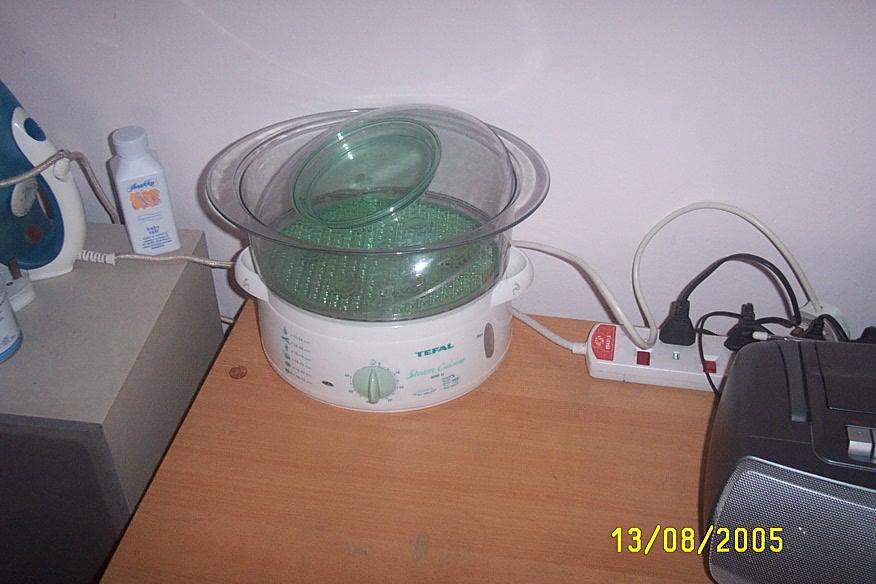 (our haze fighting machine)
What concerned me most was the effect on my family and children. After having heard a news report that asthma and breathing illness increased 150%, it worried me. I was calling back home almost every hour checking on my family and kids. My eldest daughter is potentially asthmatic and my one-year old son falls into the high risk category. Thank goodness they are fine. We tried all sort of stuff. My wife borrowed an air filter from her brother. We also told that "steaming" our rooms helped reduce the effects of the haze in our homes, which we did. I did it at my office as well. I think it worked. You should try it too.
While I was worried about the potential effect of the haze, I felt pretty helpless that there is nothing we can do about it. The thought that we cannot control things is pretty enhumbling, make one feels small and insignificant. Not sure how to deal with this yet but, right now living day by day through this hazy without any problems is top priority.
How did you deal with the haze situation?
K V
Tuesday, August 09, 2005
We remember....... how do we tell our children?
 Today, 3 days after the the first atomic bomb was dropped in Hiroshima 60 years ago, is the anniversary of the second atomic bomb was dropped over Nagasaki. As we remember the event which claimed over 150,000 lives within the span of 3 days, I was trying hard to educate my children on the effect of war.
I threw them a question, "what important world event happened this week 60 years ago". I told them to watch the news and find out for themselves. Their reply, at the end of the day was "Hiroshima!". My elder daughter could of course explain in some detail the historical detail. I on the otherhand tried to tried to insert the morals of war (rather the immorality) of war. I even managed to get them to watch (part of) the movie "Hiroshima" which detailed historically (at least that's what the CD cover claimed) the events leading up to the dropping of the atomic bombs which directly lead to the end of the second world war.
While watching the movie, my dad gently reminded me not to forget the incidents that happened before the atomic bomb was dropped - namely the atrocities the Japanese imperial army generated over the years. In Nanjing in China in 1937, the Japanese Imperial army captured Nanjing after grave atrocities were conducted. ABout 200,000 civilians were killed in the space of just 6 week. And throughout the Sino-Japanese war (1937-1945) over 7,000,000 Chinese civilians lost their lives. The damage and distruction by the atomic bomb pales in comparison to the atrocities of the Japanese Imperial Army over that period. One should not forget that the Americans came into the war with after November 1941 when the Japanese launched an air strike at Pearl Habour.
Yet, the challenge in educating our children is to teach non-violence is tough. There is not right and not wrong. Trying to tell tham that revenge is not the way and that war can be complicated affair.
After all this information communication over the past week, their response was a simple "okay, understand" and off they went to whatever they wanted to do - perhaps WW2 was too far away and cannot relate at all.
What are your thoughts and how did you talk about war with your children?
K V
Some references
http://www.bergen.org/AAST/Projects/ChinaHistory/rape.html (caution: graphic images)
http://en.wikipedia.org/wiki/Nanking_Massacre
http://users.rcn.com/mwhite28/ww2stats.htm (data & stats of casulties)
Friday, July 29, 2005
Turning Kids to Happy Readers?
One cannot help but to notice the many buntings and banners in the city to "celebrate" the national reading month. Along with the theme of "Rajin Membaca, Pasti Berjaya" (Diligent in reading, guarantee success) plastered all over the city as well, I am wondered how much money was spent on this marketing campaign while there are libraries that are in dire need for new and updated books.
I am not going to comment about the libraries - how beautifully built some are, how many internet or hi-tech accesses there are and what smart card library system there exists. I will not dwell on some of the funny rules such children a certain age are not allowed in, skirt measuring some funny length are not allowed and how strongly some library enforces them - seeking these rule breakers out and chase them out of the library. I will also not talk about the librarians who do not know / love books and who are there merely because its a job. I will not talk about Dr Haji Wan Ali's promises of a new and better library next year neither will I participate in the discussion about producing more local writers, producing local books.
What I am curious is why is there such an obsession the celebration in the month of July. I am curious about teh need to spend extra money (not on books) in this months. I am curious about the additional talk shows on radio talking about reading. However, I am really concern about what will happens after that, or rather what will not happen - people reading.
I am concern that we do not recognize that the the reading culture is the result or symptom of our social environment. We treat this so called lack of reading culture as it is the end and the main problem. Should we look at our own social environment - an environment where we do not have serious emphasis on knowledge and information. With an education systems that pays lip service to "a learner-centered education policy based on the Constructivist principal" (education minister's speech in Taylor's college, March 2005). While not having the will to move away from spoonfeeding our children. The continued examination-driven culture has narrowed our focus to reading required materials, reading to pass exams and reading because children are forced to read. What about for knowledge and personal development. What are we doing about this?
What sort of a society are we? Skip to any radio channel (all channels) at any given time of the day and you will find almost all the channels are playing music or talking about celebraties with dotting of interviews before blasting away loud music the next moment.
Browse any Free To Air (FTA) television channels and count how much information, news and commentry we get? The crux is - entertainment sells. I dread to see what would happen when Media Prima takes over NTV7. We will have all the channels selling advertisment, spoonfeeding us with almost useless news in between.
Reading is a cultural thing, cannot be changed by putting banners, posters and running campaigns. It needs to be addressed from the fabric ouf our society starting from learning and education systems, if we are lucky we will evolve over the next two generations.
For now, the best bet is from within the family. Parents need to drive and be an example of these intrinsic values.
K V Soon
further reading, check out:
http://www.ifla.org/VII/s33/project/my-report.pdf (for a report of the 2003 celebrations)
http://www.pnm.my/ (homepage of the national library)
I am not going to comment about the libraries - how beautifully built some are, how many internet or hi-tech accesses there are and what smart card library system there exists. I will not dwell on some of the funny rules such children a certain age are not allowed in, skirt measuring some funny length are not allowed and how strongly some library enforces them - seeking these rule breakers out and chase them out of the library. I will also not talk about the librarians who do not know / love books and who are there merely because its a job. I will not talk about Dr Haji Wan Ali's promises of a new and better library next year neither will I participate in the discussion about producing more local writers, producing local books.
What I am curious is why is there such an obsession the celebration in the month of July. I am curious about teh need to spend extra money (not on books) in this months. I am curious about the additional talk shows on radio talking about reading. However, I am really concern about what will happens after that, or rather what will not happen - people reading.
I am concern that we do not recognize that the the reading culture is the result or symptom of our social environment. We treat this so called lack of reading culture as it is the end and the main problem. Should we look at our own social environment - an environment where we do not have serious emphasis on knowledge and information. With an education systems that pays lip service to "a learner-centered education policy based on the Constructivist principal" (education minister's speech in Taylor's college, March 2005). While not having the will to move away from spoonfeeding our children. The continued examination-driven culture has narrowed our focus to reading required materials, reading to pass exams and reading because children are forced to read. What about for knowledge and personal development. What are we doing about this?
What sort of a society are we? Skip to any radio channel (all channels) at any given time of the day and you will find almost all the channels are playing music or talking about celebraties with dotting of interviews before blasting away loud music the next moment.
Browse any Free To Air (FTA) television channels and count how much information, news and commentry we get? The crux is - entertainment sells. I dread to see what would happen when Media Prima takes over NTV7. We will have all the channels selling advertisment, spoonfeeding us with almost useless news in between.
Reading is a cultural thing, cannot be changed by putting banners, posters and running campaigns. It needs to be addressed from the fabric ouf our society starting from learning and education systems, if we are lucky we will evolve over the next two generations.
For now, the best bet is from within the family. Parents need to drive and be an example of these intrinsic values.
K V Soon
further reading, check out:
http://www.ifla.org/VII/s33/project/
http://www.pnm.my/ (homepage of the national library)
Tuesday, July 26, 2005
Can children make their own decisions?
I came across an article by Ruth Liew in The Star (http://www.thestar.com.my) and it reminded me of a very engaging discussion with my friend a couple of days ago over this topic of getting children to make decisions by themselves.
My friend feels that children before a certain age (not sure what that age really is) - cannot make their own decision while I feel otherwise. He said that children needed to be pushed to achieve certain goals and have to successful. When I asked him what "success" meant, we move to another topic of discussion. I guess, we somewhat came to a point where we agree to disagree and our conversation drifted to the on-going British Open at that time, wondering if Tiger Woods would win the tournament of would Montie do a "come from behind" to statch a vistory.
I guess this is one place I could to share Ruth's article (below) with you with some of my own thoughts without having to abruptly change topic to golf.
I always feel that young children has the ability to choose, parents need to feed them the tools to make decisions that benefits the child and make them happy. I have always encouraged my children to choose - "would you prefer rice or noodles" and life is interesting. Sometimes they do not feel like making a decision, sometimes there are too many decisions to make. Whatever it is choices make life a little more fun.
However, somewhere in time things takes an abrupt change - usually when they go to school. Were children ever consulted if they wanted to go to school? If yes, what type of school? When they were in school, did they have a choice what to learn and how to learn them? Whatever it is, it is as if suddenly the children did not have to make decisions - not allowed to make decisions. Decisions were made for them. Will they every be able to make decision on their own as they grow older? Of course, some parents would argue that these are choices far too complex for a young mind. This is where the finer parenting skills and the philosopy of learning and teaching comes into play. Perhaps this is one of those reason and thoughts that made us embark on homeschooling adopting an "unschooling" approach - where children, basically, call the shots.
Radical thought! Some may think. Many will feel that it is easier to teach/tell/spoonfeed than to give children space and time to learn on their own. Getting kids to make decisions, learning from wrong ones, is a very long process. Usually fear steps in our minds - the parents - especially when we attempt to benchmark our children with other children. Fear arises when we think that other children are "ahead" - other could do such a thing while my child cannot. I sometimes have to remind myself that the process is long and we need to keep in constant touch with our children and to keep a watch of ourselves as well.
I totally agree with Ruth's phrase that states that "we must not change our children but ourselves". In this whole learning experience at home, I continue to question myself whenever I get impatient with my children - is it me or is it my children with a problem. If we think deeper, its usually the us parents, expressing out fears and insecurities. I find this piece of advise powerful as it forces one to look inwards. In our modern world, we sometimes have no time or no inclination to do so.
I guess there is still so much to learn about being a parent. It is so easy to listen to what other people tells us and how society dictates what is right and what is wrong - so much so that we lose confidence in our abilities as parents.
Perhaps it is about time we think about our own strength and weaknesses and not be afraid to face them. Lest, our children will learn our ways.
K V
My friend feels that children before a certain age (not sure what that age really is) - cannot make their own decision while I feel otherwise. He said that children needed to be pushed to achieve certain goals and have to successful. When I asked him what "success" meant, we move to another topic of discussion. I guess, we somewhat came to a point where we agree to disagree and our conversation drifted to the on-going British Open at that time, wondering if Tiger Woods would win the tournament of would Montie do a "come from behind" to statch a vistory.
I guess this is one place I could to share Ruth's article (below) with you with some of my own thoughts without having to abruptly change topic to golf.
I always feel that young children has the ability to choose, parents need to feed them the tools to make decisions that benefits the child and make them happy. I have always encouraged my children to choose - "would you prefer rice or noodles" and life is interesting. Sometimes they do not feel like making a decision, sometimes there are too many decisions to make. Whatever it is choices make life a little more fun.
However, somewhere in time things takes an abrupt change - usually when they go to school. Were children ever consulted if they wanted to go to school? If yes, what type of school? When they were in school, did they have a choice what to learn and how to learn them? Whatever it is, it is as if suddenly the children did not have to make decisions - not allowed to make decisions. Decisions were made for them. Will they every be able to make decision on their own as they grow older? Of course, some parents would argue that these are choices far too complex for a young mind. This is where the finer parenting skills and the philosopy of learning and teaching comes into play. Perhaps this is one of those reason and thoughts that made us embark on homeschooling adopting an "unschooling" approach - where children, basically, call the shots.
Radical thought! Some may think. Many will feel that it is easier to teach/tell/spoonfeed than to give children space and time to learn on their own. Getting kids to make decisions, learning from wrong ones, is a very long process. Usually fear steps in our minds - the parents - especially when we attempt to benchmark our children with other children. Fear arises when we think that other children are "ahead" - other could do such a thing while my child cannot. I sometimes have to remind myself that the process is long and we need to keep in constant touch with our children and to keep a watch of ourselves as well.
I totally agree with Ruth's phrase that states that "we must not change our children but ourselves". In this whole learning experience at home, I continue to question myself whenever I get impatient with my children - is it me or is it my children with a problem. If we think deeper, its usually the us parents, expressing out fears and insecurities. I find this piece of advise powerful as it forces one to look inwards. In our modern world, we sometimes have no time or no inclination to do so.
I guess there is still so much to learn about being a parent. It is so easy to listen to what other people tells us and how society dictates what is right and what is wrong - so much so that we lose confidence in our abilities as parents.
Perhaps it is about time we think about our own strength and weaknesses and not be afraid to face them. Lest, our children will learn our ways.
K V
Thursday July 21, 2005
Learning from children
Children are gifts from God. They also bear gifts for us to help us understand our lives on Earth. For this, we must pause and ponder upon our role as parents to help children reveal their gifts to us.
The gifts children bring to us lie within them, waiting to be discovered. These gifts include compassion, generosity, kindness, love, care, cooperation, appreciation and forbearance. They cannot be taught but drawn out from within the child. Adults who know this allow children to develop without suppression and pressure to perform before they are ready.
Many children hardly have any opportunities to develop these gifts. They are hurried to achieve school success so that they can later get a good job and have a good standing in society. The success in life is measured by how much they make in life, not what kind of people they become.
Parents who send their children to preschool, ask the teacher: “Have they learned to read yet?” or “Are they able to do addition or subtraction?” They would never ask: “Did my son get to help his friends today?” or “Did she marvel at the beautiful dew drops on the flowers?”
Children have an innate sense of appreciation. They look at things around them and marvel at their existence. They have many questions about their world. Sadly, adults do not appreciate their keenness and would hurry the children to get on with things and do something useful other than observing the ant trail.
We must not change our children but ourselves. We must re-examine ourselves and our priorities. Children will behave negatively when they are forced to go against their nature. We do not emphasise on the values that they like to work on. They want to be cooperative but we tell them that it is better for them to be competitive. We want them to be the top student in class.
What do you do when your child shows compassion towards a homeless person on the street?
Do you tell your child that you are proud of him for assisting his classmate in a difficult task? Or, do you tell him not to lose his things in school and not to lend anyone anything?
A Year One boy I approached to borrow his class timetable told me: “My mother said I cannot lend anyone anything in school.”
I only needed to take a look at his copy of the timetable because my daughter had lost hers. When he finally relented, I praised him and asked him to let his mother know that he has helped a friend in need.
To draw out the gifts from our children, we must support them in the process of unravelling. We must give them time and space for them to actively participate in the making of humanity. We must not hurry them to learn the things they are not ready for. We must allow them to wonder and admire the forces of nature at work. Do not take on the role of teacher but be your child’s learner. He may teach you a thing or two about life that you have long forgotten.
Wednesday, July 20, 2005
What should schools aim for?
On Wednesday, July 13, 2005, PM Datuk Seri Abdullah Badawi said that the main thrust of schools is unity - to ensure the nations's continued peace. he said that the younger generation must be given early opportunities to understand the meaning of unity through ways and practices that would ensure the people were united and lived in harmony.
One thought immediately are came to my mind - what about helping our young generation acquire knowledge and personal development?
I quickly check with the educational philosophy of the the Ministry of Education and it states:
"Education in Malaysia is an on-going efforts towards further developing the potential of individuals in a holostic and integrated manner, so as to produce individuals who are intelectually, spiritually, emotionally and physically balanced and harmonic, based on a firm belief in and devotion to God. Such an effort is designed to produce Malaysian citizens who are knowledgeable and competent, who possess high moral standards and who are responsible and capable of achieving high level of personal well-being as well as being able to contribute to the harmony and betterment of the family, the society and the nation at large"
For over 40 years we have tried to build the foundation for national unity with all sorts of initiatives. Shouldn't the politicians seriously think and act on unity from the political parties and not load the schools? Isn't about time schools start giving focus on developing the individual?
KayVee
The STAR - Wednesday July 13, 2005
Aim for unity, schools told
SEREMBAN: Unity should be the main thrust of Malaysian schools to ensure the nation’s continued peace and stability, Prime Minister Datuk Seri Abdullah Ahmad Badawi said.
He said the younger generation must be given early opportunities to understand the meaning of unity through ways and practices that would ensure the people were united and lived in harmony.
“This is important. We want them to know what is unity. We understand there is a slight difference, as there are Chinese schools and also national schools.
“There are also students of different races in national schools but the number is small. As such unity must be promoted with activities that are beneficial to promoting unity,” he told reporters after launching the national-level Integration Plan for Student Unity at SJK (C) Chung Hwa near here yesterday.
Also present were Education Minister Datuk Seri Hishammuddin Tun Hussein, Housing and Local Government Minister Datuk Seri Ong Ka Ting, Negri Sembilan Mentri Besar Datuk Seri Mohamad Hasan, state executive councillors and senior officers of the education ministry and state education department.
Abdullah said unity must be imbued at an early stage, as today’s younger generation still had no prejudice against friends of different races and religions.
He ticked off parents who poisoned the minds of their children with unhealthy sentiments but said not all were responsible of such acts. He added that parents should support their children in activities that were aimed at promoting unity.
He said the older generation had long imbued the spirit of tolerance and avoided creating uneasiness among races, and this approach was adopted by the Government in various programmes aimed at promoting racial unity.
On the integration plan for student unity (Rimup) and its guidebook, Abdullah expressed hope that the programme would succeed in its objectives.
Rimup was introduced in 1986 when Abdullah was Education Minister. The programme, aimed at promoting racial unity through sports, co-curriculum and gotong-royong activities, was reactivated after nearly 20 years.
One thought immediately are came to my mind - what about helping our young generation acquire knowledge and personal development?
I quickly check with the educational philosophy of the the Ministry of Education and it states:
"Education in Malaysia is an on-going efforts towards further developing the potential of individuals in a holostic and integrated manner, so as to produce individuals who are intelectually, spiritually, emotionally and physically balanced and harmonic, based on a firm belief in and devotion to God. Such an effort is designed to produce Malaysian citizens who are knowledgeable and competent, who possess high moral standards and who are responsible and capable of achieving high level of personal well-being as well as being able to contribute to the harmony and betterment of the family, the society and the nation at large"
For over 40 years we have tried to build the foundation for national unity with all sorts of initiatives. Shouldn't the politicians seriously think and act on unity from the political parties and not load the schools? Isn't about time schools start giving focus on developing the individual?
KayVee
The STAR - Wednesday July 13, 2005
Aim for unity, schools told
SEREMBAN: Unity should be the main thrust of Malaysian schools to ensure the nation’s continued peace and stability, Prime Minister Datuk Seri Abdullah Ahmad Badawi said.
He said the younger generation must be given early opportunities to understand the meaning of unity through ways and practices that would ensure the people were united and lived in harmony.
“This is important. We want them to know what is unity. We understand there is a slight difference, as there are Chinese schools and also national schools.
“There are also students of different races in national schools but the number is small. As such unity must be promoted with activities that are beneficial to promoting unity,” he told reporters after launching the national-level Integration Plan for Student Unity at SJK (C) Chung Hwa near here yesterday.
Also present were Education Minister Datuk Seri Hishammuddin Tun Hussein, Housing and Local Government Minister Datuk Seri Ong Ka Ting, Negri Sembilan Mentri Besar Datuk Seri Mohamad Hasan, state executive councillors and senior officers of the education ministry and state education department.
Abdullah said unity must be imbued at an early stage, as today’s younger generation still had no prejudice against friends of different races and religions.
He ticked off parents who poisoned the minds of their children with unhealthy sentiments but said not all were responsible of such acts. He added that parents should support their children in activities that were aimed at promoting unity.
He said the older generation had long imbued the spirit of tolerance and avoided creating uneasiness among races, and this approach was adopted by the Government in various programmes aimed at promoting racial unity.
On the integration plan for student unity (Rimup) and its guidebook, Abdullah expressed hope that the programme would succeed in its objectives.
Rimup was introduced in 1986 when Abdullah was Education Minister. The programme, aimed at promoting racial unity through sports, co-curriculum and gotong-royong activities, was reactivated after nearly 20 years.
Tuesday, July 05, 2005
Converstion with my 11 month old Son
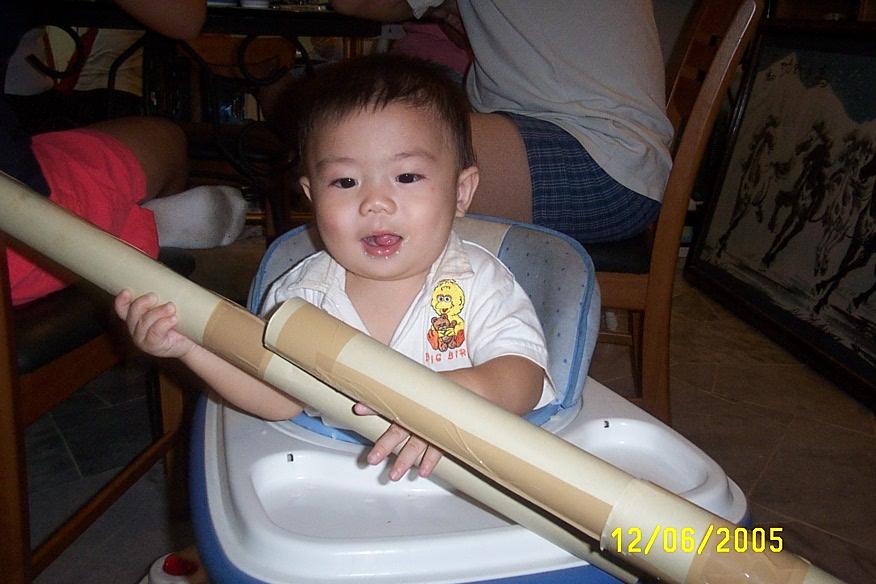
How can one have a conversation with a child who cannot yet speak? It is interesting to understand and appreciate the fact that children do understand and can respond if we focus our minds and attention to them - there is always something they are trying to say. There is also something I am trying say to my 11 month old son. I am trying to reach to him and acknowledge each other.
Over the last weekend, my wife decided to impart her wisdom and reminded me that, in order to connect with this little boy I will have to do things with him. I will need to get to the stuff he enjoys and make that connection. And last weekend I did just that. Spend as much time as I could to play and connect with him. Of course, the the key element is focus and committment to it.
When I finally did, I was overjoyed with the connection I got. I felt he was speaking to me, he was telling what he likes to do, how to do it and I am responding. I also expressed to him some of the things I did and how to do it - such as praying. He responded by gesturing my hands in the way I taught him
Over the years, as my older daughters grew up and got into more speech communication, I lost the non-verbal communication capability. Now my son is teaching me (again) the importance of this level of communication.
Until the time he blabbers away - I shall remain in this communications state, and enjoying it.
Thursday, January 13, 2005
A conversation with my 8 year old daughter
This evening my eight year old daughter and I had a conversation while driving to meet a friend. I asked her about her conversation with her mum she had earlier where she fully expressed herself and how she felt about learning and schooling. I asked her about her learning experience and what she felt about school (she is being home-schooled). She clearly expressed how she felt about on one part she wished she could experience what school is like and on the other how she is currently enjoying her home school learning process. I could understand where she was coming from and what she would like to have. I understand that these thoughts were the cumulated of her interaction with with her friends who are attending public school.
I told her that we were proud of her ability to express herself. She was trying to understand why we were proud – and the questions started coming – why dad? I explained that the level of social maturity of an individual lies in his or her ability to communicate. This is one of the things that I have told here that what this ability separates the adults from the kids. She felt satisfied.
I then asked her what she felt about school – her answer, almost before thinking she replied “why schools cannot make learning more fun?” I asked why she said that. Her reply was that her friends (at least some of them) hated school and are bogged down by homework. She then went on to talk more in depth.
I now sitting here trying to understand and appreciate that our daughter is growing up and beginning to have thoughts of her own and we will need to respect that. Sometimes, we get so involved in too many things and impose too many of our values to our children that we have little of no time to listen or reflect on what our children say.
I guess, this little conversation was a reminder that I need to sit up and spend more time to listen more – our children are going up so fast and we may not know what went past us only to regret we miss them.
KayVee
Monday, January 10, 2005
It has been over 2 weeks since the dreadful Boxing Day tsunami disaster which has claimed more than 100,000 lives happened. I am still trying to understand and comprehend the scale of this destruction. With almost every international news channel reporting all angles of the story, it is a challenge not to take this as just a story and watch the news with emotional attachment. After watching and following news for over two week, it is becoming “just another story”. We need to continually be able to see the stories with our hearts.
In
Our family have made the donations, gave what we could to the different organizations to be handed over to organizations to be send to the needy.
“May their suffering be lighten as time passes,
May mythoughts give them strength to find inner strength to move forward in life.
May these strengths give rise to wisdom that compassion will grow.
To see the value of the life.
May all beings be well”
May all beings be well”
Sabbe satta sukhi hotu!
KayVee
Saturday, January 01, 2005
Welcome 2005.....
With this thought and feeling, I fund it difficult to wish my dear friends any of my friends a happy new year. Instead, I have however, this message for you all:
“ ............................................... “
(A time to reflect, find inner peace and move forward)
Regards,
Kayvee
Tuesday, December 14, 2004
Monopoly or Gameboys: Can we have children earn their gifts?
I have nephew who has this habit of wanting things. He is now 11 years old. When he was about eight, he would drive me and my wife nuts whenever he came to stay with us – we had to endure endless cries of “I want….., I want…..”. Getting him to say “please” was the most enormous task indeed. Over the past couple of years, he had tone down the “I wants..” and getting him to say “please” was not too difficult, yet the challenge remains. I guess I am the only uncle that ignores him when gets into his “I want…” mode. When he sees I do not respond, the polite mode kicks in – at least he knows.
Recently I went shopping with him and his grandparents. He went into his “I want..” mode and in pops a eighty-over-ringgit Monopoly set. I was uneasy. I have never known this young boy to enjoy Monopoly. He has never mentioned about the game Monopoly. It is a game he does not play well – if he even knows how to play at all. I went around the shopping center with this uneasy thought in my mind that he got his grandfather to give him what he wants just because he wants it – not really to enjoy playing it. When we reached the payment counter, his grandfather, gave him RM80 to be given to me as I was paying for the rest of the groceries and stuff.
Immediately an idea came up and the very next moment I challenged my nephew that I will buy the Monopoly, save granddad his hard earn ringgit and get into a game with me. If he wins, he gets to keep the set. If he does not, he will probably have to play until he wins – that is if he does not give up half-way through, which he has the tendency to. I am not really a Monopoly player myself but I have played enough to under and appreciate the game. His first reaction was that he will keep granddad’s money and take the easy way out. When I asked him again, he thought for a while and then said with a determined tone, “I will take you challenge!” and off he went to return the money to his granddad.
While walking back to car, his impatience stepped in and his mind started to change. I told him that it was his own choice and if he wanted to he could change his mind, if he wanted to do so. He did not. I guess it was a struggle for him. Anyway, the family grand Monopoly challenge will take place in 5 days time. I was hoping that his determination to want it is great enough that he will strive for it.
When I got back home, my children, who witnessed the whole episode engaged in a conversation with me over this event. My younger daughter (7 years old) remarked that some parents are so good and that whatever their children wanted their parents would buy for them. My elder one (8 years old) joined in felt that children should earn their gifts in some way. My two daughters experienced over 8 months of painstaking point collection (points awarded for chores and studies activities) before each of them got their little “gameboy” game console. When I asked my older daughter again, would she be prefer to earn all he gifts, her reply was, “sometimes”. My younger daughter then concurred. This last statement struck me! I am starting to wonder if I am actually teaching my children to appreciate and respect the gifts the get.
Would you have made a stand or just let it be and have the grandparents and my nephew do and get what they want. Reflecting my daughter’s remark that sometimes kids need to get stuff because they are kids and kids naturally want stuff they like. On the other hand the challenge is teaching our kids to appreciate the things they have. I find it a challenge to strike a balance and there is no gauge to determine if you have done the right thing.
I guess sometimes we just buy because we want to and give because we want to and sometime we get them to earn them – we could do it by digging deep into out parental nature to strike the balance.
What are your thoughts and what would you have done?
KayVee
Saturday, December 11, 2004
Ring Size or Ring Price: Thoughts on getting married
What ring would you buy your fiancé / wife-to-be?
I just had teh-tarik with a friend who will be getting married in a couple of months. They are now at the mist of their preparation. In our conversation, the topic of the size of the diamond ring came up. When my friend got engaged recently, he bought for his fiancé a small diamond ring which cost less then RM 1000. However, because of peer and relative pressure, he had to fork out close to RM 2000 for a wedding ring – an amount a little off budget based on the salary he is currently earning. Along with this ring of course comes with other items such as designer apparels, accessories and even a house! My friend lamented and expressed the feared that romance and love is gradually being transformed into a financial battle – even before marriage! He is concern that financial matters will be a stumbling block to a happy marriage.
I am just wondering, if this is a common problem with the people of the younger generation. I remembered that my own parents when they were married, they lived in a rented room that called “home”. It was only until my sister was born (three years after me), that my parents moved into their first house. It was not a bad thing during those days. I was not that different as well, my wife and I got our own house 12 years after our marriage – three kids later. My parents and to some similar extent, just lived according to their means and were happy.
Of course, at that time they did not have credit cards that allowed them to spend first, pay [interest] later. There were no minimum payment required too. I guess at that time, it was okay to start small, lead a simple life and gradually take in more complexity when we are able to take their challenge. Reflecting this with my friend, he also related the stories of is friends in the same predicament. Sometimes I wonder if our younger generation knows or is able to live simple lives and within their means.
Subscribe to:
Posts (Atom)